
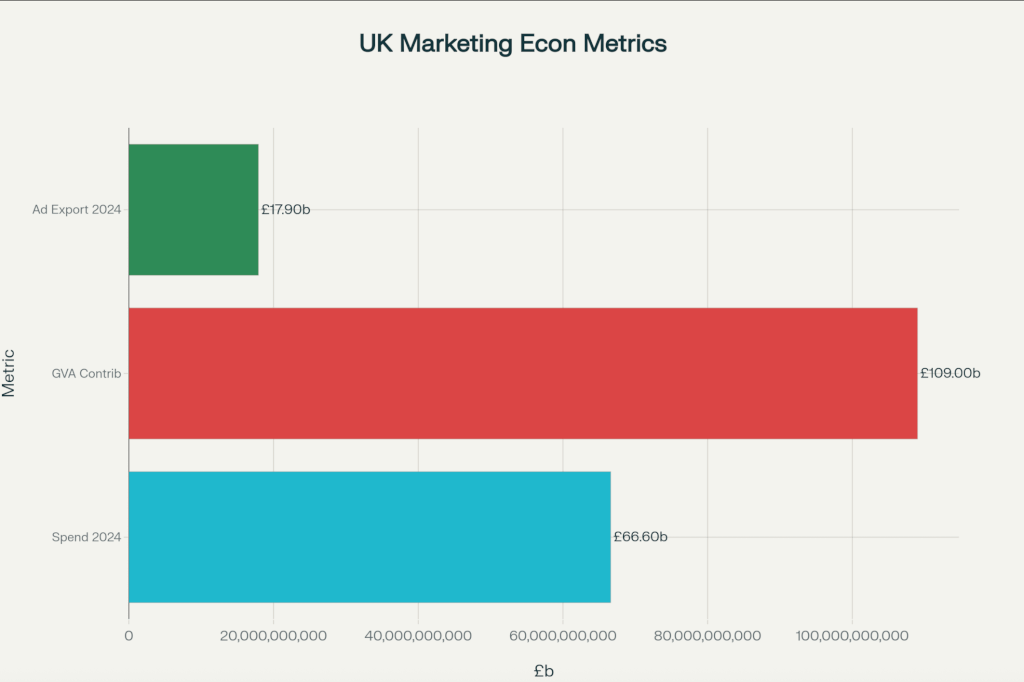
Marketing isn’t just about flashy adverts and catchy slogans. It’s a fundamental driver of Britain’s economic prosperity, contributing a staggering £109 billion to the UK’s Gross Value Added (GVA) in 2024. That’s 4% of our entire economic output, supporting 1.7 million jobs and generating remarkable returns for businesses across the nation.
Understanding GDP and GVA: The Economic Foundations
Before we examine marketing’s impressive contribution, let’s clarify what GDP and GVA actually mean. Gross Domestic Product (GDP) represents the total monetary value of all finished goods and services produced within a country during a specific period[1]. It’s essentially the headline figure that tells us how large an economy is and whether it’s growing or shrinking.
Gross Value Added (GVA), meanwhile, measures the value of goods and services produced in an area, industry, or sector, minus the cost of inputs and raw materials used in production[2][3]. GVA is actually the building block of GDP. The relationship works like this: GDP equals GVA plus taxes on products minus subsidies on products[3].
Think of GVA as the pure value creation happening within our economy. When a brewery transforms barley, hops, and yeast into beer, the difference between what they pay for those ingredients and what they receive for the finished product represents their GVA contribution[4]. This measure helps us understand which sectors genuinely add value to our economic output.
The UK’s total GDP reached £2.56 trillion in 2024[5], whilst our GVA sits at approximately £2.73 trillion. This makes marketing’s £109 billion contribution particularly significant – it represents genuine value creation, not just economic activity.
Marketing’s Remarkable Economic Impact
The latest research from Credos, the advertising industry’s think tank, reveals marketing’s extraordinary economic footprint. In 2024, 3.5 million businesses spent an estimated £66.6 billion on advertising and marketing activities[6][7]. This investment wasn’t just cost – it was a powerful economic catalyst.
Here’s what makes these figures particularly impressive: every pound spent on advertising now generates an average profit return of £4.11 for medium to large businesses, and £1.89 for micro and small enterprises[7]. This isn’t just marketing theory – it’s measurable economic impact that ripples through our entire economy.
Marketing supports 1.7 million jobs across the UK, representing 5% of total employment[7]. Remarkably, 60% of these positions are based outside London, with the North West accounting for 12% of marketing employment, followed by the South East at 11% and Yorkshire and Humber at 8%[7]. This demonstrates how marketing’s economic benefits extend far beyond the capital.
The industry also punches well above its weight internationally. UK advertising services exports reached £17.9 billion in 2024[8], making Britain second only to the United States in global advertising exports. Previous data shows UK advertising and market research exports totalled £15.2 billion in 2022, representing a 32.5% year-on-year increase[9].
Britain’s Position Among World Economic Powers
To understand marketing’s contribution properly, we need to appreciate Britain’s position in the global economic hierarchy. The UK maintains its status as the world’s sixth-largest economy, with a GDP of $3.84 trillion in 2025[10][11][12].
| Rank | Country | GDP (USD Trillions) | GDP Per Capita (USD) |
|---|---|---|---|
| 1 | United States | $30.51 | $89,110 |
| 2 | China | $19.23 | $13,690 |
| 3 | Germany | $4.74 | $55,910 |
| 4 | India | $4.19 | $2,880 |
| 5 | Japan | $4.19 | $33,960 |
| 6 | United Kingdom | $3.84 | $54,950 |
| 7 | France | $3.21 | $46,390 |
| 8 | Italy | $2.42 | $41,090 |
| 9 | Canada | $2.23 | $53,560 |
| 10 | Brazil | $2.13 | $9,960 |
This ranking has remained remarkably stable. Britain has held the sixth position since 2017[13], though economic forecasters suggest it may retain this position through to 2039[14]. The stability of this ranking, despite Brexit uncertainties and global economic turbulence, speaks to the underlying strength of the UK economy.
What’s particularly noteworthy is Britain’s GDP per capita of $54,950, which places it well above the global average and demonstrates the productive capacity of our workforce. This productivity creates the environment where marketing investments can generate such substantial returns.
Beyond the Numbers: Marketing’s Multiple Value Demonstrations
Marketing’s economic value extends far beyond the direct financial contributions. The industry demonstrates value through several interconnected mechanisms that amplify its impact across the broader economy.
Productivity Enhancement Through Information Flow
Marketing serves as the economy’s information system, connecting supply with demand more efficiently than would otherwise be possible. Research consistently shows that advertising reduces search costs for consumers whilst enabling businesses to achieve economies of scale more rapidly[15]. This information flow function alone is estimated to add £120 billion to UK GDP by raising the level of economic activity and boosting productivity[16].
When businesses can communicate effectively with potential customers, they achieve faster growth, require less working capital per pound of sales, and can specialise more effectively. This productivity boost cascades through supply chains, benefiting suppliers, distributors, and service providers.
Innovation Catalyst and Risk Reduction
Marketing enables innovation by providing a mechanism for businesses to communicate new product benefits to potential customers. Without effective marketing, innovative products face much higher failure rates because consumers remain unaware of their advantages. Research from the Institute of Practitioners in Advertising shows that advertising investment during economic downturns actually provides higher returns than investment during growth periods[17].
This occurs because marketing reduces the risk premium that consumers and businesses apply to new purchases during uncertain times. Companies that maintain marketing investment during downturns often emerge with stronger market positions and higher market share.
Employment Multiplier Effects
Marketing’s employment impact extends far beyond the 1.7 million directly employed in marketing roles. The industry provides the primary revenue stream for numerous other sectors: commercial radio and television (100% of revenue), business magazines (85%), regional newspapers (75%), national quality newspapers (61%), and consumer magazines (35%)[18].
The Advertising Association estimates that companies across Britain whose business depends on advertising revenue account for 4.25 million jobs[18]. This includes not just media roles, but technical positions in broadcasting, journalism jobs in newspapers and magazines, and creative roles in content production.
Market Competition and Consumer Benefit
Marketing intensifies competition by making it easier for new entrants to communicate their advantages to potential customers. This competitive pressure drives innovation, improves quality, and reduces prices across the economy. Economic research consistently shows that markets with higher advertising intensity tend to have lower prices and higher rates of innovation.
The consumer benefits are substantial. Marketing-driven competition has contributed to price reductions in numerous sectors. For instance, the mobile phone market’s transformation from a premium service to mass market accessibility was largely enabled by marketing communications that explained new tariff structures and service benefits to consumers.
Export Performance and Global Competitiveness
Britain’s strength in marketing services contributes directly to our export performance and international competitiveness. The UK advertising sector exports £18 billion of services annually – four times as much as UK music exports and eight times as much as UK television exports[8].
This export success reflects Britain’s world-leading creative capabilities and deep expertise in marketing communications. London remains acknowledged alongside New York as one of the two world centres of creative advertising[18]. This global recognition attracts international investment, supports high-skilled employment, and generates foreign exchange earnings.
The creative industries more broadly, of which marketing forms a crucial component, contributed £124.6 billion of GVA to the UK economy in 2022, representing 5.7% of total GVA[9]. This sector has grown 6% since 2019, demonstrating resilience even through challenging economic conditions.
Technological Innovation and Digital Leadership
Marketing drives adoption of new technologies by communicating their benefits and reducing adoption risk. The UK’s leadership in e-commerce – where our share of retail sales through digital channels at 30% is the highest in the world, ahead of the US at 24%[6] – partly reflects our sophisticated marketing capabilities.
This digital leadership creates competitive advantages across multiple sectors. British businesses become early adopters of new technologies, achieve higher productivity through digital tools, and develop expertise that can be exported globally.
Regional Economic Development
Marketing’s economic benefits extend throughout the UK, not just London and the South East. The distribution of marketing employment shows 60% of jobs are now based outside London[7]. This geographical spread ensures that marketing’s economic benefits support regional development and help address regional economic imbalances.
The North West, with 12% of marketing employment, demonstrates how the sector supports economic development beyond traditional financial centres. Similarly, Yorkshire and Humber’s 8% share shows marketing’s role in supporting diverse regional economies.
The ROI Reality: Measuring Marketing’s Economic Returns
Understanding marketing’s return on investment requires looking beyond simple cost-benefit calculations. Modern marketing ROI measurement recognises that marketing investments create value through multiple channels and timeframes[19][20].
Direct Revenue Attribution
The most straightforward measurement shows that every £1 spent on advertising generates £4.11 in profit for medium to large businesses and £1.89 for micro and small businesses[7]. However, this direct attribution understates marketing’s full economic impact because it doesn’t capture all the ways marketing creates value.
Productivity and Efficiency Gains
Marketing investments reduce the cost of customer acquisition, enable businesses to achieve optimal capacity utilisation more quickly, and reduce the working capital required for growth. These efficiency gains often exceed the direct revenue benefits but are harder to measure precisely.
Research shows that businesses with higher marketing intensity achieve faster growth with lower capital requirements[21]. This efficiency translates into higher returns on invested capital and faster economic growth.
Market Development and Category Growth
Marketing doesn’t just redistribute existing demand – it often creates new categories and expands overall market size. The development of categories like sports drinks, premium coffee, and streaming services required substantial marketing investment to educate consumers and create demand.
This market development function generates economic benefits that extend far beyond the original marketing investment. New categories create employment, attract investment, and often export expertise and products globally.
Long-term Brand Value Creation
Marketing investments create intangible assets in the form of brand recognition, customer loyalty, and market position. These assets appear on company balance sheets and contribute to business valuations, but their economic impact extends beyond individual companies.
Strong brands command premium prices, achieve higher customer retention rates, and require lower marketing costs to maintain market position. This efficiency creates economic surplus that benefits consumers through better products and services, employees through higher wages, and shareholders through better returns.
Economic Resilience and Future Growth
Marketing’s contribution to economic resilience became particularly evident during recent economic challenges. The industry demonstrated its ability to adapt quickly to changing circumstances whilst maintaining its economic contribution.
During the pandemic, marketing spend initially declined but recovered rapidly as businesses recognised marketing’s essential role in maintaining customer relationships and driving recovery. The latest data shows marketing budgets growing across all major categories, with events marketing leading at +17.2% growth, main media budgets up +3.5%, and direct marketing increasing for the sixth consecutive quarter at +8.9%[22].
This resilience reflects marketing’s fundamental role in economic activity. Businesses cannot reduce marketing investment indefinitely without damaging their market position and growth prospects. Recognition of this relationship has led to more strategic approaches to marketing investment.
Corporate financial prospects have reached their most optimistic levels in nearly three years, with a net balance of +13.6% expecting improved performance[22]. This confidence partly reflects recognition that marketing investment during uncertain times often produces higher returns than investment during more stable periods.
Policy Implications and Economic Development
Marketing’s substantial economic contribution has important implications for government policy and economic development strategy. The sector’s 4% GVA contribution and 5% employment share make it a significant component of the UK economy that deserves policy attention.
Skills development represents a crucial policy area. The marketing sector faces persistent shortages in key areas such as strategy, project management, copywriting, and social media[8]. Additionally, increasing demand for digital and data skills, particularly in artificial intelligence, machine learning, and data science, requires coordinated policy responses.
The Government’s commitment to reform the Apprenticeship Levy and replace it with a Growth and Skills Levy could address some of these challenges[8]. However, the marketing sector’s specific needs require careful consideration in policy design.
International competitiveness also demands policy attention. Britain’s position as a global leader in marketing services creates opportunities for export growth and inward investment. Maintaining this leadership requires continued investment in creative and digital skills, supportive regulatory frameworks, and recognition of marketing’s economic importance.
The creative industries more broadly, including marketing, are identified as one of the government’s top five priority growth missions[9]. This recognition creates opportunities for targeted support that could amplify marketing’s already substantial economic contribution.
The Competitive Advantage of Marketing Excellence
Britain’s marketing excellence creates competitive advantages that extend far beyond the sector itself. Our global leadership in creative advertising, digital marketing innovation, and marketing services exports demonstrates how sectoral excellence can drive broader economic performance.
The concentration of marketing expertise in Britain attracts international investment, supports high-skilled employment, and creates knowledge spillovers that benefit other sectors. Companies locate their European or global marketing operations in Britain partly because of our deep expertise and creative capabilities.
This expertise clustering creates virtuous cycles. Success attracts talent, talent drives innovation, innovation creates new opportunities, and new opportunities attract further investment. These dynamics help explain why London remains one of only two global centres of creative advertising excellence.
The economic benefits extend through supply chains and business networks. Suppliers to marketing agencies, technology providers serving marketing departments, and service providers supporting marketing activities all benefit from Britain’s marketing excellence.
Future Opportunities and Economic Potential
Looking ahead, marketing’s economic contribution shows strong potential for continued growth. Several trends suggest opportunities for expansion of marketing’s economic impact.
Digital transformation continues creating new opportunities for marketing innovation and economic contribution. The integration of artificial intelligence, machine learning, and data analytics into marketing practice promises to enhance productivity and effectiveness further.
Sustainability marketing represents another growth area. As businesses respond to climate change and environmental concerns, marketing plays a crucial role in communicating sustainability benefits and driving adoption of environmentally friendly products and services.
International expansion opportunities remain substantial. Britain’s creative and marketing expertise has global appeal, and export growth could significantly increase marketing’s economic contribution.
The development of new marketing technologies and techniques in Britain could also drive export growth and inward investment. Our leadership in programmatic advertising, marketing automation, and digital analytics creates opportunities for technology export alongside service exports.
Regional Development and Economic Balance
Marketing’s economic benefits increasingly support regional development across Britain. The shift of 60% of marketing employment outside London represents a significant economic opportunity for regional economies[7].
Cities like Manchester, Leeds, Birmingham, and Bristol have developed substantial marketing clusters that support local economic development. These clusters create high-skilled employment opportunities, attract young talent, and support broader creative and digital sector development.
The regional distribution of marketing activity also supports media diversity and local business development. Regional advertising agencies serve local businesses that might otherwise struggle to access marketing expertise, whilst local media benefits from regional advertising spending.
This geographical distribution of marketing’s economic benefits helps address regional economic imbalances and supports the levelling up agenda. Marketing jobs tend to be well-paid, skill-intensive, and relatively mobile, making them valuable components of regional economic development strategies.
The Social and Cultural Dimension
Marketing’s economic contribution extends beyond measurable financial impacts to include social and cultural benefits that support broader economic development. The sector’s role in funding media content, supporting cultural activities, and enabling business communication creates value that’s difficult to quantify but economically important.
The funding of commercial television, radio, and digital media through advertising revenue provides content that entertains, informs, and educates the population. This content provision represents a significant economic value that would otherwise require public funding or consumer payment.
Similarly, marketing’s support for cultural activities, sports sponsorship, and community events creates social benefits that support economic development indirectly. These activities improve quality of life, attract tourism, and create positive business locations that support broader economic activity.
Technology Leadership and Innovation
Britain’s marketing sector increasingly drives technology innovation with global applications. Our leadership in marketing technology development, data analytics, and digital advertising creates export opportunities and attracts international investment.
The development of programmatic advertising technology, marketing automation platforms, and customer data platforms in Britain has created new export industries and attracted global technology investment. These developments demonstrate how marketing excellence can drive broader technology sector development.
Artificial intelligence applications in marketing represent another area where Britain’s expertise creates economic opportunities. Our combination of creative excellence, technical capability, and regulatory sophistication positions us well to lead in AI-powered marketing innovation.
Measuring Success: Beyond Traditional Metrics
Marketing’s economic value measurement continues evolving as understanding of the sector’s contribution deepens. Traditional metrics like direct revenue attribution capture only part of marketing’s economic impact.
More sophisticated measurement approaches recognise marketing’s role in productivity enhancement, risk reduction, market development, and innovation facilitation. These broader measures suggest marketing’s economic contribution may be even larger than current estimates indicate.
The development of better measurement methodologies also creates export opportunities. Britain’s expertise in marketing measurement and analytics has global applications and supports our position as a centre of marketing excellence.
The Integration Challenge
One of marketing’s greatest economic contributions lies in its integrative function – connecting different parts of the economy more efficiently. Marketing enables specialisation by facilitating communication between specialist producers and diverse consumers.
This integrative function becomes increasingly valuable as the economy becomes more complex and specialised. Without effective marketing, the transaction costs of connecting supply and demand would constrain economic development and limit the benefits of specialisation.
The development of digital marketing capabilities has enhanced this integrative function significantly. Online advertising, social media marketing, and digital analytics enable much more precise matching of supply and demand, reducing waste and improving economic efficiency.
Looking Forward: Marketing’s Economic Future
Marketing’s £109 billion GVA contribution and 4% share of economic output establishes the sector as a major economic force. However, this contribution represents current achievement rather than future potential.
Several factors suggest opportunities for expanded economic contribution. Continued digital transformation, growing international demand for British marketing expertise, and the development of new marketing technologies all point toward growth opportunities.
The integration of artificial intelligence, machine learning, and advanced analytics into marketing practice promises significant productivity gains. These technological advances could enhance marketing effectiveness whilst reducing costs, creating additional economic surplus.
International expansion represents another major opportunity. Britain’s creative excellence and marketing expertise have global appeal, and export growth could significantly increase the sector’s economic contribution.
The development of marketing technologies and platforms in Britain could also drive broader economic benefits. Our combination of creative talent, technical expertise, and regulatory sophistication creates opportunities for technology leadership with global applications.
Marketing’s economic contribution extends far beyond its direct financial impact. The sector serves as an economic catalyst, productivity enhancer, and innovation driver that amplifies its influence throughout the economy. Understanding this broader contribution helps appreciate why marketing represents such a valuable component of Britain’s economic success.
From supporting 1.7 million jobs to generating £17.9 billion in exports, from driving productivity improvements to enabling innovation, marketing’s economic value permeates every aspect of our economic system. As Britain navigates global economic challenges and opportunities, recognising and supporting marketing’s contribution becomes increasingly important for maintaining our competitive position and economic prosperity.
The evidence is clear: marketing isn’t just about selling products – it’s about powering economic growth, supporting employment, driving innovation, and maintaining Britain’s position among the world’s leading economies. That’s a contribution worth celebrating and supporting.
References and Further Reading
[1] Report: Advertising is contributing increasing amounts to the UK … https://newdigitalage.co/advertising/advertising-pays-2025-credos/
[2] Economic indicators: Key statistics for the UK economy https://commonslibrary.parliament.uk/research-briefings/cbp-9040/
[3] What’s causing the surge in UK marketing sector spend? | theHRD https://www.thehrdirector.com/business-news/business/whats-causing-surge-uk-marketing-sector-spend/
[4] Advertising contributes £100bn to UK economy – Marketing Week https://www.marketingweek.com/advertising-contributes-100bn-to-uk-economy/
[5] [PDF] Advertising – GOV.UK https://assets.publishing.service.gov.uk/media/5a7b696de5274a34770eb84d/Creative_Industries_Mapping_Document_Advertising.pdf
[6] What Advertising Leaders Expect to See From This Labour … https://creative.salon/articles/features/what-the-ad-industry-thinks-the-next-british-government-should-do-to-strengthen-business
[7] New report shows UK economic growth and jobs powered by … https://adassoc.org.uk/our-work/new-report-shows-uk-economic-growth-and-jobs-powered-by-advertising-investment/
[8] The UK Data Driven Market – GOV.UK https://www.gov.uk/government/publications/the-uk-data-driven-market/the-uk-data-driven-market
[9] [PDF] Written evidence from the UK Advertising Association (SFF0116) https://committees.parliament.uk/writtenevidence/130840/pdf/
[10] Creative industries article great.gov.uk international https://www.business.gov.uk/invest-in-uk/investment/sectors/creative-industries/
[11] Influencer Advertising – United Kingdom | Market Forecast – Statista https://www.statista.com/outlook/amo/advertising/influencer-advertising/united-kingdom
[12] Business insights and impact on the UK economy: 20 March 2025 https://www.ons.gov.uk/businessindustryandtrade/business/businessservices/bulletins/businessinsightsandimpactontheukeconomy/20march2025
[13] Annual Review 2023: Advertising’s Contribution to the UK Economy https://adassoc.org.uk/our-work/annual-review-2023-advertisings-contribution-to-the-uk-economy/
[14] Facts and Figures – The Creative Industries https://www.thecreativeindustries.co.uk/facts-figures
[15] Gross Domestic Product (GDP) – Office for National Statistics https://www.ons.gov.uk/economy/grossdomesticproductgdp
[16] The London Market grows contribution to UK economy to £50bn https://lmg.london/news/londonmatters/
[17] Marketing in the United Kingdom – statistics & facts – Statista https://www.statista.com/topics/9016/marketing-in-the-united-kingdom/
[18] How Advertising Fuels the Economy – The Creative Industries https://www.thecreativeindustries.co.uk/facts-figures/industries-advertising-advertising-facts-and-figures-how-advertising-fuels-the-economy
[19] Advertising Association—written evidence (CRF0013) https://committees.parliament.uk/writtenevidence/111032/html/
[20] Gross Domestic Product (GDP) Formula and How to Use It https://www.investopedia.com/terms/g/gdp.asp
[21] Gross Value Added (GVA): Definition, Formula, and Example https://www.investopedia.com/terms/g/gross-value-added.asp
[22] United Kingdom GDP – Trading Economics https://tradingeconomics.com/united-kingdom/gdp
>>> Why Marketing Deserves the Spotlight in UK Business



Leave a Reply