Multi-touch attribution for small B2B sounds like the sort of phrase that belongs in a large corporate dashboard, beside complicated charts and a team of analysts. In reality, it is a practical way for a small business to understand how marketing contributes to enquiries, sales opportunities and new clients.
I often see small B2B firms put all the credit for a new lead on the final action. Someone completes a contact form after finding a service page on Google, so Google search gets the credit. That may be partly true, but it rarely tells the full story.
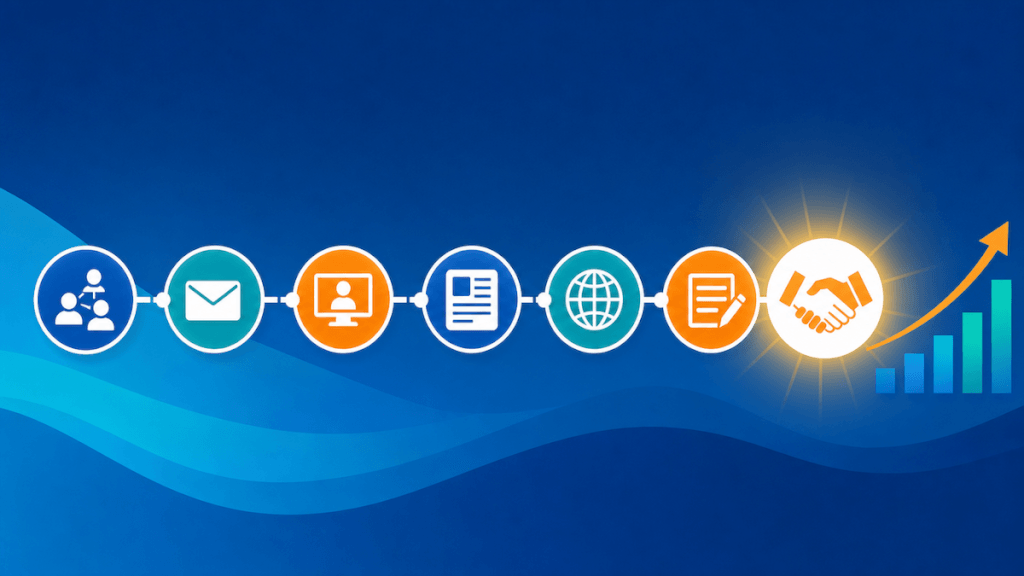
Before filling in that form, the prospect may have read a LinkedIn post, joined a webinar, received an email, visited the website twice and checked a case study. Multi-touch attribution helps us see more of that journey. It is not about chasing perfect data. It is about making better decisions with the information we already have.
What Is Multi-Touch Attribution for Small B2B?
Multi-touch attribution is a way of sharing credit for a conversion across several interactions. Google explains that single-touch models assign all conversion credit to one interaction, while multi-touch attribution distributes credit across the customer journey.
For a small B2B business, a conversion might be a booked discovery call, a useful guide download, a webinar registration or a new sales opportunity. The aim is to understand which activities helped move a prospect from mild interest to a meaningful conversation.
That matters because B2B buying is rarely instant. A managing director may see your name on LinkedIn in January, download a guide in March and book a call in May. If we only measure the final form submission, we risk cutting the earlier marketing that helped create trust.
A simple example
Imagine a professional services firm wins a £20,000 project. The client’s journey could look like this:
They first notice a LinkedIn post, later visit a blog post, download a checklist, attend a webinar and then book a meeting after receiving an email. Last-touch reporting may give all the credit to email. Multi-touch reporting recognises that the email was important, but it was not working alone.
This does not mean every interaction deserves identical credit. It means we should avoid treating the last click as the whole story.
Why Last-Touch Reporting Can Mislead
Last-touch reporting is popular because it is simple. It tells us what happened immediately before a form submission or purchase. That can be useful, especially when we are reviewing a specific campaign.
The problem comes when we use it as the only measure of success. In B2B, prospects often return directly to a website after seeing several earlier pieces of marketing. Google Analytics notes that direct visits normally do not receive attribution credit unless the path consists entirely of direct visits.
So, a prospect may see an insightful article shared by a colleague, remember your name, and later type your web address directly into their browser. The original influence is hard to capture, yet it may have been the moment that made the difference.
This is especially relevant for small B2B firms where reputation, referrals, networking and helpful content all work together. If we only reward the final action, we may over-invest in conversion activity and under-invest in building familiarity.
Choose a Practical Attribution Model
You do not need a sophisticated data science project to begin. I would start by choosing one model that fits how your business sells, then compare it with last-touch reporting over time.
Linear attribution
A linear model gives equal credit to every recorded interaction. It is easy to explain and can be a sensible first option for a small B2B firm with a long buying cycle.
Its weakness is that it assumes every touchpoint has the same value. A quick page visit is unlikely to matter as much as a detailed consultation or a well-attended webinar. Still, it is often better than pretending only the final click mattered.
U-shaped and W-shaped attribution
U-shaped attribution places more weight on the first interaction and the point where a prospect becomes a lead. W-shaped attribution adds greater weight to the moment an opportunity is created.
These can be helpful where the sales process is clear and your CRM records stages consistently. HubSpot’s attribution reporting can measure which interactions contribute to contact and deal creation, while revenue attribution is available with Marketing Hub Enterprise.
Full-path attribution
Full-path attribution gives greater importance to four major moments: first interaction, lead creation, deal creation and closed-won. It can be a good fit for B2B businesses with longer sales cycles and several people involved in a purchase.
However, I would not make full-path reporting your starting point if your CRM data is inconsistent. Good attribution depends on clean deal records, sensible lifecycle stages and marketing activity that is properly tracked.
Start With Data You Can Trust
The best multi-touch attribution for small B2B is usually modest, consistent and useful. Before choosing another dashboard, make sure the basics are in place.
Every campaign should have a clear name, and every link you share should use consistent UTM tracking. This makes it easier to identify whether traffic came from LinkedIn, an email, a partner campaign, paid search or another source.
It is also worth agreeing what counts as a qualified lead and what counts as a genuine opportunity. If sales opportunities are created in different ways by different people, the reports will become difficult to trust.
In HubSpot, revenue attribution relies on closed-won deals and associated contacts, with key deal values such as amount, create date and close date recorded. That is a useful reminder that attribution is only as good as the CRM habits behind it.
My minimum viable setup
For many small B2B firms, I would begin with a simple monthly view of:
- First known source of new contacts
- Latest source before enquiry
- Content or campaigns viewed before an opportunity was created
- Marketing activity linked to closed-won deals
That is enough to spot patterns. You may find that LinkedIn creates early awareness, webinars help turn interest into enquiries, and email keeps warm prospects moving. Each channel then has a clearer role in the wider system.
Use Attribution to Improve Decisions
The purpose of attribution is not to prove that one channel is the winner and everything else should stop. It is to understand how your activities work together.
If a webinar series appears in the journeys of many qualified opportunities, that is a strong signal to improve and promote it. If a paid campaign creates plenty of form fills but few sales conversations, you can investigate the targeting, landing page or follow-up process.
Google Ads uses data-driven attribution as its default model for many conversion actions. It uses account data to estimate the contribution of interactions across conversion paths. That can be useful for advertisers with enough reliable data, but small B2B businesses should still apply judgement rather than accepting any report without question.
[1]
For me, the real value comes from asking better questions. Which activities introduce us to the right people? Which ones help build confidence? Which ones lead to proper conversations? And which are present when clients decide to buy?
Do Not Chase Perfect Attribution
No attribution model captures every influence. Offline conversations, referrals, private WhatsApp groups, recommendations and word of mouth are difficult to track. Even digital data can be incomplete because prospects switch devices, block cookies or research anonymously.
That is not a reason to give up. It is a reason to treat attribution as informed evidence rather than absolute proof.
I would combine reporting with a simple question on enquiry forms and sales calls: “How did you first hear about us?” The answers will not always match the analytics, but they add useful context. A prospect may say “LinkedIn” even if their final website visit came from Google.
Make the Next Step Simple
If you are new to multi-touch attribution for small B2B, do not start by buying another platform. Start with your existing CRM, website analytics and campaign data. Choose one attribution view, improve your tracking discipline and review the findings each month.
Over time, you will build a more realistic picture of how people become clients. That helps you protect the work that creates awareness, invest in the activity that builds trust and improve the conversion points that turn interest into revenue.
For a small B2B business, that is more than enough. Better visibility leads to better marketing decisions, and better decisions tend to produce stronger commercial results.
References and Further Reading
UTM stands for Urchin Tracking Module. It is a small piece of text added to the end of a web link. Analytics tools like Google Analytics use these tags to see exactly where website visitors come from and how they found the page.
Google Privacy Sandbox: Multi-Touch Attribution. https://privacysandbox.google.com/private-advertising/private-aggregation/multi-touch-attribution
Google Analytics Help: Get started with attribution. https://support.google.com/analytics/answer/10596866?hl=en
HubSpot Knowledge Base: Add Report Filters. https://knowledge.hubspot.com/reports/create-attribution-reports
OneIMS: A Complete Guide to HubSpot Multi-Touch Attribution. https://oneims.com/blog/hubspot-multi-touch-attribution
Google Ads Help: About attribution models. https://support.google.com/google-ads/answer/6259715?hl=en-GB
[1]

Leave a Reply