
Understanding the trust equation
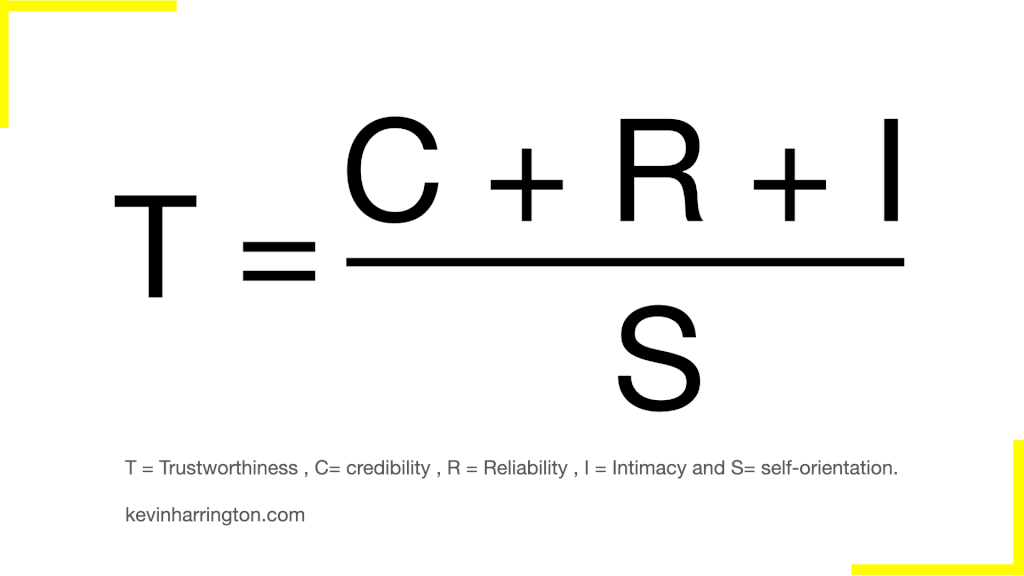
The trust equation is a simple way to think about why we trust some people and organisations more than others. In its most practical form, the trust equation says that trust is built when competence and reliability are high, and perceived selfishness is low.
And here us is the trust equation
![\[ \text{Trustworthiness} = \frac{\text{Credibility} + \text{Reliability} + \text{Intimacy}}{\text{Self-orientation}} \]](https://www.kevinharrington.com/wp-content/ql-cache/quicklatex.com-82c15a3dd89199c1b45dea99ccc30c6a_l3.png "Rendered by QuickLaTeX.com")
A widely used version, building on the work of David Maister, Charles Green and Robert Galford, describes trustworthiness like this: trust equals credibility plus reliability plus intimacy, all divided by self-orientation. In other words, the more capable, consistent and human you are, and the less self-interested you appear, the more people will trust you.
How the trust equation applies to individuals
Competence: can you actually do the work
Competence is about whether you can deliver what you promise. Do you have the skills, knowledge and judgement to do the job in front of you, whether that is running a workshop, designing a strategy or holding a difficult conversation
In my experience, many professionals assume competence is enough to build trust by itself. It is not. Competence is the ticket to the game. If you are not competent, trust will be fragile at best. If you are competent and visibly getting better over time, you increase your trust score and make it easier for others to say yes to working with you again.
Reliability: do you do what you say
Reliability is about consistency. Do you keep your promises. Do you turn up on time. Do you send the follow up note you said you would send. People notice patterns, and those patterns become their shortcut for trusting or not trusting you.
A practical habit that helps here is making fewer promises and keeping all of them. If you cannot commit, say so. If circumstances change, communicate early rather than hoping no one will mind. Over time, your reputation for reliability can outweigh the odd mistake, because people have a strong pattern of you following through.
Intimacy: do people feel safe with you
Intimacy sounds like a strange word in a business context, yet it simply means emotional closeness and safety. Do people feel they can tell you the truth. Do they feel you listen without jumping straight to your own agenda. Do you respect what they share with you.
This is not about becoming everyone’s best friend. It is about being present, curious and respectful. Asking better questions. Leaving space for silence. Remembering that behind every “client” is a person with their own pressures and fears. When people feel understood, trust deepens, even if you cannot always give them the answer they want.
Selfishness or self-orientation: who are you really serving
The denominator in the trust equation is selfishness, sometimes called self-orientation. This is about who you appear to be serving. Are you primarily focused on your own targets, your own ego, your own timetable. Or do people see you genuinely trying to help them succeed.
What matters here is perception as much as intent. You might care deeply about your clients or colleagues, yet if your behaviour looks self-interested, trust will fall. That could be as simple as talking more than you listen, pushing your preferred solution too fast, or hiding bad news to avoid discomfort. Lowering your visible selfishness is often the fastest way to raise trust.
Applying the trust equation to companies and brands
Competence at organisational level
For companies, competence shows up in the quality and relevance of products and services. Do they solve real problems. Are they safe, robust and well supported. When a brand keeps shipping things that work in the real world, customers start to assume competence as a given.
In B2B and professional services, competence also includes sector understanding and the ability to translate that into practical advice. A firm that publishes clear, useful insights and then backs them up in client work steadily increases its perceived competence. Over time, that makes it easier for buyers to justify choosing that firm again.
Reliability in customer and client experience
Brand reliability is about consistency over time. Does the company do what it says on the website. Are delivery times realistic. Is the billing accurate. How does the organisation behave when something goes wrong. All of these shape the reliability score in the trust equation for brands.
Many organisations still underestimate how damaging small inconsistencies can be. A slick marketing promise followed by clumsy onboarding creates a gap that erodes trust. On the other hand, a brand that is transparent about what it can and cannot do, and then reliably meets those commitments, builds long term loyalty even without flashy campaigns.
Brand intimacy: human connection at scale
Brand intimacy is about how close customers feel to the organisation. Do they feel seen and understood. Is the communication human, not robotic. Are complaints handled with empathy rather than scripts. People are more likely to forgive mistakes when they believe there are real humans on the other side who care.
This is where tone of voice, customer service culture and even leadership visibility matter. When senior leaders show up in human ways, whether that is on stage, in videos or in written posts, they help customers and employees feel closer to the brand. That closeness boosts trust in line with the trust equation.
Corporate selfishness and self-orientation
The denominator in the trust equation is where many brands struggle. If customers believe a company is primarily out for itself, trust falls, even if the products are competent and the service is mostly reliable. We see this when firms hide price increases in the small print, or when they shift risk onto customers to hit short term targets.
Brands can reduce perceived selfishness by being honest about trade-offs, owning their mistakes, and demonstrating that they are willing to sacrifice some short term gain to do the right thing. Clear refund policies, fair contracts and transparent communication all signal lower self-orientation, which raises the overall trust score.
Using the trust equation in your work
A simple self check
One practical way I use the trust equation is as a self check before and after key interactions. I ask myself four questions. Have I shown enough competence for this conversation. Have I behaved reliably over time with this person. Have I created any sense of closeness or psychological safety. Have I kept my own agenda in check.
You can apply the same questions at team or company level. For example, when designing a new service, ask how it demonstrates competence, how it will deliver reliability, how it can build intimacy with users, and what might reduce perceived selfishness. You will not get it perfect, yet the act of asking shifts decisions towards greater trust.
Trust equation as a shared language
The trust equation also gives teams a shared language. Instead of vague statements like “our clients do not trust us”, you can ask which part of the equation is weakest. Do clients doubt your competence. Have you broken reliability in the past. Are you too transactional and distant. Or have you been perceived as acting mainly in your own interest.
Once you know where the trust equation is weakest, you can design specific actions to address it. That might be investing in training, tightening delivery processes, changing how you communicate, or revisiting incentives that encourage selfish behaviour. Over time, small consistent changes compound into a stronger trust position for both individuals and brands.
References and Further Reading
ModelThinkers – Trust Equation. https://modelthinkers.com/mental-model/trust-equation
Tick HR – What is the Trust Equation. https://www.tickhr.com/what-is-the-trust-equation/
Small Giants Community – The Power of Trustworthiness: Demystifying the Trust Equation. https://blog.smallgiants.org/trust-equation
People Shift https://people-shift.com/articles/the-trust-equation/
Jostle Blog – Trust equation: how to assess trust. https://blog.jostle.me/blog/trust-equation

Leave a Reply