If you have been working in B2B marketing for any length of time, you will have encountered a persistent challenge. You pour resources into lead generation campaigns, chase after prospects who seem interested, and wonder why your conversion rates remain stubbornly low. Perhaps you have spent countless hours perfecting your sales funnel, only to see potential customers disappear without explanation. The problem might not be your tactics. It could be your timing.
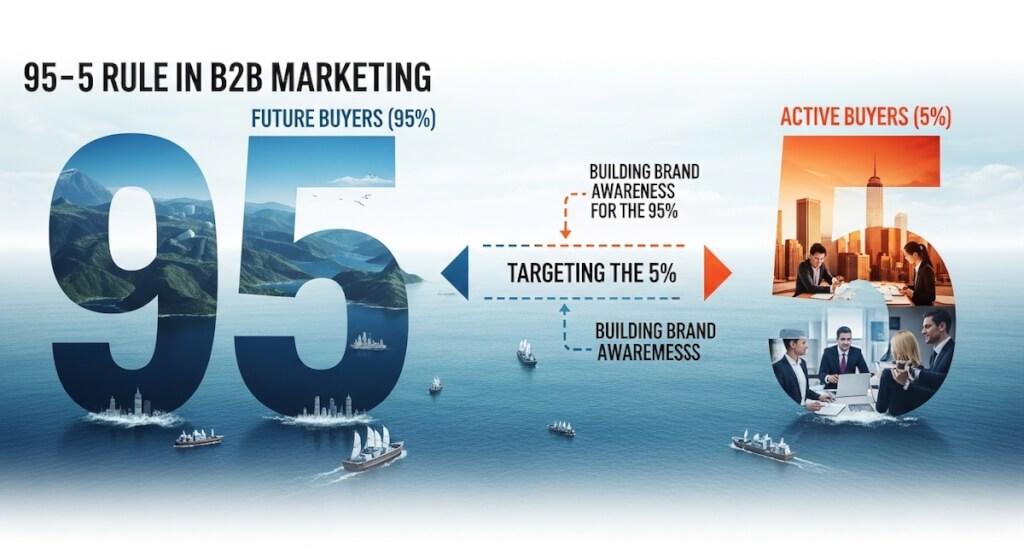
The 95-5 rule offers a profound insight into this challenge. Research from the Ehrenberg-Bass Institute reveals that at any given moment, only 5% of your total addressable market is actively looking to buy[1][2][3]. The remaining 95% are not in-market. They might need your product or service eventually, but right now they are locked into existing contracts, satisfied with current providers, or simply not ready to make a purchase decision. Understanding this reality changes everything about how you should approach B2B marketing.
I have been writing about marketing for years, and this concept fundamentally shifted how I think about building brands and creating demand. When you accept that most of your audience is not ready to buy today, you stop wasting money trying to convince the unconvinceable. Instead, you invest in being remembered when the time comes. This is not about giving up on short-term results. It is about balancing immediate sales activation with long-term brand building to create sustainable growth.
Understanding the 95-5 Rule
The 95-5 rule is deceptively simple, yet its implications are profound for anyone involved in B2B marketing strategy. Let me explain where this concept came from and what it actually means for your business.
The Origins of the 95-5 Rule
Professor John Dawes from the Ehrenberg-Bass Institute for Marketing Science first articulated the 95-5 rule after studying B2B purchasing patterns[1][2][4]. His research examined how frequently businesses actually enter the market for various goods and services. What he discovered was striking. Corporations change service providers roughly once every five years on average[1]. That means only about 20% of business buyers are in-market over the course of an entire year. In any given quarter, that figure drops to approximately 5%[1][2].
The Ehrenberg-Bass Institute, based at the University of South Australia, has built its reputation on evidence-based marketing research[5][6]. Rather than relying on theory or anecdote, they analyse real purchasing data across multiple categories and markets. Their work on how brands actually grow has challenged many long-held assumptions in marketing. The 95-5 rule emerged from this rigorous approach to understanding buyer behaviour[7][4].
LinkedIn’s B2B Institute later partnered with Ehrenberg-Bass to validate and expand upon these findings[3][8]. Their joint research confirmed that this pattern holds across different B2B categories. Whether you are selling enterprise software, professional services, or industrial equipment, the vast majority of your potential customers are not actively buying at any given time[9][3].
What the Numbers Actually Mean
When Dawes states that 95% of buyers are out-of-market, he is not suggesting that 95% will never buy from you[2][4]. He is highlighting a timing issue. These buyers already have what you are selling and will not need a replacement for months or years[1]. They might be locked into multi-year contracts with competitors. Perhaps their budget cycle means they cannot make purchasing decisions until next fiscal year. Or maybe they have other priorities consuming their attention and resources right now.
The 5% who are in-market face immediate pain points or opportunities that demand action[10][3]. Their contracts are expiring, their current solutions are failing, or business circumstances force them to seek alternatives. This group is actively researching options, comparing vendors, and preparing to make decisions. Naturally, every marketer wants to reach these buyers. The competition for their attention is fierce[10].
However, here is the crucial insight. The 95% who are out-of-market today will eventually become the 5% who are ready to buy[3][8]. Buyers constantly move in and out of the market based on changing needs, budgets, and circumstances[11]. The question becomes: when they enter the market, will they think of your brand? If they have never heard of you before they start their buying process, your chances of winning their business are slim to none[3][12].
Research from 6sense shows that 81% of buyers already have a preferred vendor when they make first contact with suppliers[12]. More than 90% have prior experience with at least one of the vendors they consider[12]. This means the battle for mindshare happens long before the battle for market share. You need to build brand memories with the 95% so that when they transition to the 5%, your brand is the one they remember[13][3].
Why the 95-5 Rule Matters for B2B Marketers
Understanding that most of your audience is not ready to buy might seem discouraging at first. In reality, this knowledge liberates you from chasing an impossible goal. Let me explain why this matters so much for how you allocate your time, budget, and creative energy.
The Problem with Lead Generation-Only Strategies
Many B2B organisations have become addicted to lead generation[14][15][16]. The appeal is obvious. You launch a campaign, track downloads of your whitepaper or registrations for your webinar, and count the leads flowing into your CRM. Your sales team gets excited about new prospects to chase. Senior leadership sees measurable activity that looks like marketing is “doing something” to drive revenue. Everyone feels productive.
The problem is that lead generation only captures existing demand among the tiny fraction of buyers who are already in-market[17][16]. You are not creating new demand. You are competing with every other vendor for the attention of the same small group of active buyers[18]. When multiple companies target the same 5%, acquisition costs skyrocket and differentiation becomes nearly impossible[7].
Even worse, an over-reliance on lead generation creates a dangerous short-term focus[10][15]. You chase quick wins that show up in this quarter’s pipeline but starve your future growth. When you only market to people ready to buy today, you are invisible to everyone else[19]. The 95% of future buyers never encounter your brand, never learn what you do, never develop any awareness or preference. Then when they do enter the market months or years later, they shortlist competitors instead of you[3][20].
Research shows that 96% of B2B marketers expect their advertising campaigns to show significant impact within two weeks[21]. This belief is a myth[21]. Most B2B advertising works by creating lasting brand impressions long before buyers enter the market[18][3]. The sales you generate today are largely the result of brand-building investments you made months or years ago[22][23].
Long Buying Cycles and Multiple Decision-Makers
The 95-5 rule becomes even more critical when you consider the realities of B2B purchasing. The average B2B sales cycle now lasts between 6 and 11 months depending on which research you consult[24][12][25]. For complex enterprise deals, cycles can stretch to 16 months or longer[25]. During this extended period, buyers conduct extensive research, build business cases, secure internal approvals, and evaluate alternatives[12].
Multiple stakeholders complicate the process further. The average B2B buying group includes 10 to 11 people for most decisions[12][25]. For enterprise deals, that number climbs to around 15 stakeholders[25]. Each person brings different priorities, concerns, and decision criteria. Getting them all aligned behind your solution takes time and patient cultivation of relationships.
Here is what makes this challenging. You probably will not interact with all these stakeholders directly[12][26]. Research shows that 80% of B2B buyers prefer to initiate first contact themselves, and they typically do so when they are already 70% through their purchasing process[12]. By the time a buyer reaches out to your sales team, they have already formed strong opinions about potential vendors. If your brand was not part of their research journey, you are starting from a severe disadvantage.
This is why marketing to the 95% matters so much. You cannot wait until buyers enter the market to start building awareness and preference. The lengthy consideration process and the anonymous research phase mean your brand needs to be present and memorable throughout the buyer’s journey, not just at the end[9][20][26]. When you invest in brand building that reaches out-of-market buyers, you ensure your brand is already familiar and trusted when those buyers eventually need what you offer[18][3].
The Science Behind the 95-5 Rule
The 95-5 rule is not just an interesting observation. It rests on solid research into how human memory and decision-making actually work. Two key concepts from marketing science explain why this rule has such profound implications.
Mental Availability in B2B
Professor Byron Sharp, director of the Ehrenberg-Bass Institute, introduced the concept of mental availability in his influential book “How Brands Grow”[27][28][29]. Mental availability refers to the probability that a buyer will notice, recognise, or think of a brand in a buying situation[27][29][30]. It depends on the quality and quantity of memory structures related to the brand stored in a buyer’s mind[29].
Think of mental availability as your brand’s position in the customer’s memory[28][29]. When someone faces a problem your product solves, does your brand come to mind quickly? When they see your logo or hear your company name, do they immediately understand what you do and why it matters? The more easily and frequently a brand is thought of in relevant buying situations, the higher its mental availability[13][27].
Mental availability works alongside physical availability (how easy it is to actually buy from you) to drive brand growth[13][28][31]. You need both. If buyers think of your brand but cannot easily engage with your sales process, you lose opportunities. If you are easy to buy from but no one thinks of you, you never get considered. However, for the 95% who are out-of-market, physical availability is irrelevant right now. They are not trying to buy anything. Mental availability is what matters[18][3].
Building mental availability takes time and consistency[18][28]. You create memory structures through repeated exposure to distinctive brand elements across multiple contexts. This is why big brands like Coca-Cola and Apple advertise constantly even though everyone already knows who they are[18]. They are maintaining and strengthening their mental availability so that when buying situations arise, their brands spring to mind effortlessly.
Research from Rob Brittain and Peter Field analysed campaigns that overperformed in driving mental availability[30]. These campaigns also had stronger impacts on business metrics including new customer acquisition, customer retention, and pricing power[30]. They yielded better short-term sales responses and long-term gains in market share[30]. Mental availability is not just a fuzzy brand concept. It correlates directly with commercial success.
Category Entry Points
Jenni Romaniuk, another research professor at Ehrenberg-Bass, developed the concept of category entry points (CEPs)[32][33][34]. Category entry points are the cues that buyers use to access their memories when faced with a buying situation[32][35]. These can include internal cues like motives and emotions or external cues like locations, times, and events[35].
For example, imagine you are marketing project management software. Category entry points might include situations like “starting a new project”, “team members missing deadlines”, “struggling to track multiple workstreams”, or “executive asking for status updates”. Each of these situations could trigger a buyer to think about project management solutions[33]. If your brand is strongly associated with these category entry points, buyers will think of you when they encounter these situations[32][34].
Understanding category entry points revolutionises how you approach marketing[35]. Instead of just trying to be “top of mind” generally, you focus on being remembered in the specific situations where buyers need your category[33][36]. You build associations between your brand and the relevant buying triggers[32]. This means your marketing creative, your content, and your messaging all work to link your brand to the moments that matter most.
The power of category entry points becomes clear when you consider that most purchases start not with searching on Google but with searching our memory[35]. Before buyers open a browser, they first think “I need something to solve this problem”. The brands that come to mind in that moment are the ones that get researched and shortlisted[35]. If your brand is not associated with the relevant category entry points, you will not even be considered.
For B2B brands, identifying and owning key category entry points is crucial for capturing share among the 95% who are out-of-market[32][34][35]. When these buyers eventually face the situations that bring them into your category, you want yours to be the brand they immediately think of. This requires consistent, long-term investment in building and reinforcing those memory associations[32][36].
How the 95-5 Rule Changes Your Marketing Approach
Accepting the 95-5 rule forces you to rethink almost everything about your marketing strategy. The good news is that this shift makes your marketing more effective and more sustainable. Here is how your approach needs to change.
Brand Building vs Sales Activation
Marketing essentially serves two functions. Sales activation drives immediate responses like clicks, leads, and short-term sales[23][37][38]. Brand building creates long-term memory structures that influence future purchasing decisions[22][23][38]. Both are necessary. The question is how you balance them.
Research by Les Binet and Peter Field, who analysed decades of marketing effectiveness data, found that the optimal balance for most brands is roughly 60% brand building and 40% sales activation[22][23][38]. For B2B specifically, their research with LinkedIn’s B2B Institute suggests a 50-50 split, though this varies by industry, company size, and life stage[15][16][39].
Brand building focuses on creating emotional connections and mental availability with broad audiences over extended periods[22][23][38]. It uses reach, repetition, and distinctive creative to build memory structures. Sales activation targets narrower audiences with rational messages designed to trigger immediate action[18][40][37]. It uses channels like paid search, retargeting, and targeted outreach to capture demand from buyers ready to act now.
The 95-5 rule explains why brand building matters so much in B2B[9][3][20]. If 95% of your potential buyers are not ready to purchase, then 95% of your marketing efforts should focus on reaching and influencing these future buyers[3]. You need to invest in strategies that build mental availability so that when the out-of-market majority eventually enter the market, your brand is the one they remember[18][35][41].
This does not mean you abandon lead generation. You still need sales activation to convert the 5% who are in-market right now[18][40]. However, you recognise that without brand building, your lead generation becomes progressively less effective and more expensive over time[42][16]. Brand building amplifies your sales activation by ensuring more buyers think of you when they enter the market[42][43].
Balancing Your Marketing Budget
So how much should you invest in reaching the 95% versus the 5%? While the specific split depends on your circumstances, the principle is clear. B2B brands dramatically under-invest in brand building relative to what the evidence suggests is optimal[39][44][43].
LinkedIn’s research found that in 2020, only 9% of B2B marketers devoted more than 60% of their budget to long-term programmes[42]. This figure was down from 21% the year before[42]. Most B2B organisations skew heavily towards sales activation, often spending 80% or more of their budget on lead generation and demand capture[15][16].
This imbalance creates several problems. First, you are over-investing in competing for the small fraction of buyers who are in-market right now while under-investing in building preference among the large fraction who will be in-market later[43][41]. Second, your sales activation becomes less efficient because you have not built adequate brand awareness and preference to make those tactics work harder[42][16]. Third, you become invisible to future buyers who never encounter your brand until it is too late to influence their decisions[9][3].
The brands that achieve the best long-term results invest at least 50% of their budget in brand building[39][43]. This investment protects future cash flows by ensuring a steady stream of buyers who already know, trust, and prefer your brand when they enter the market[35][43][41]. While brand building takes longer to show returns than sales activation, those returns are larger and more sustainable[22][23][38].
One challenge B2B marketers face is proving the value of brand investments to leadership teams focused on quarterly results[42][43][41]. This is where reframing the conversation helps. Instead of talking about brand love and creative awards, talk about protecting future cash flows[35][43][41]. Most companies value themselves based heavily on projected future revenues. If 95% of buyers are out-of-market, then 95% of your future revenue depends on winning those buyers when they eventually enter the market[3][41].
Emotional vs Rational Messaging
Another widespread myth in B2B marketing is that rational, feature-focused messages work better than emotional ones because business buyers make logical decisions[45][40][46]. Research thoroughly debunks this belief. Studies by Binet and Field found that B2B campaigns using emotional strategies are 7 times more effective at producing large business impacts than those using rational approaches[45][40][47].
Why does emotion work so well in B2B? Because business buyers are still human beings making decisions under uncertainty[46]. They face significant personal risk when choosing vendors. Selecting the wrong solution could damage their reputation, hurt their team’s productivity, or even cost them their job[46]. Emotion provides the reassurance they need to overcome this risk and commit to a purchase[46].
Google and the CEB Marketing Leadership Council found that B2B customers are significantly more emotionally connected to their vendors than consumers are to B2C brands[46]. The stakes are higher, the relationships matter more, and the emotional drivers around trust, confidence, and validation become crucial[46][47].
This connects directly to the 95-5 rule. For the 5% who are in-market right now, rational messages about features, specifications, and ROI calculations have a place[40][37]. These buyers are actively comparing options and need the facts to justify their decisions[40]. However, for the 95% who are out-of-market, rational messages are ignored and forgotten because they lack immediate relevance[18][10].
Emotional messaging, by contrast, creates memorable impressions that stick with out-of-market buyers[18][45][47]. Emotions help encode memories more strongly than facts do. When you make someone feel something, they are more likely to remember your brand months or years later when they finally need what you sell[47]. This is why bold, creative, emotionally resonant brand campaigns drive superior long-term results even though they might not generate immediate leads[45][47].
Implementing the 95-5 Rule
Understanding the 95-5 rule is one thing. Actually changing how you market based on this understanding is another. Here are practical ways to implement this approach in your organisation.
Content Strategy for Out-of-Market Buyers
Your content strategy needs to serve both audiences. For the 5% who are in-market, create bottom-of-funnel content like product comparisons, case studies, ROI calculators, and demo videos[48][49]. These resources help active buyers evaluate options and build business cases. This is the domain of product marketing and sales enablement.
For the 95% who are out-of-market, your content strategy looks completely different[19][48][50]. You are not trying to convince anyone to buy right now. You are trying to build awareness, establish credibility, and create mental associations that will pay off later. This requires top-of-funnel content focused on education, thought leadership, and addressing the broader challenges your category solves[48][51][49].
When Gong’s content team started building their brand, they had one hard rule: no talking about the product[19]. For the first year, they focused entirely on creating the most engaging sales content in their space. They produced insights, data, and stories that sales professionals wanted to consume regardless of whether they were considering new sales technology[19]. This strategy built massive awareness and preference among the 95% of their audience who were not ready to buy Gong yet.
Your content for out-of-market buyers should address the problems and situations that eventually lead people into your category[51][49][52]. If you sell HR software, create content about workforce trends, leadership challenges, and organisational development. If you sell manufacturing equipment, produce insights about supply chain resilience, quality control, and operational efficiency. The goal is to be helpful and interesting to your audience before they are ready to buy from anyone[48][50].
Frequency and consistency matter enormously for reaching out-of-market buyers[18][53][20]. One whitepaper or webinar does not build mental availability. You need sustained presence over time. Regular blog posts, consistent social media engagement, podcast appearances, industry event participation, all of these touchpoints collectively build the memory structures that drive future consideration[18][48].
Creating Distinctive Brand Assets
Distinctive brand assets are the visual, verbal, and sensory elements that make your brand instantly recognisable[54][55][56]. Think of McDonald’s golden arches, Apple’s minimalist design aesthetic, or Nike’s swoosh[54]. These assets act as shortcuts in people’s memory, making it easier to notice and recall the brand[55][56][57].
B2B brands typically under-invest in building distinctive assets[56]. Research analysing 300+ assets from 59 B2B brands across six categories found that almost all brands tested lacked any truly distinctive brand assets[56]. While buyers claimed to recognise many assets, correct brand attribution scored in single digits[56]. This means B2B brands are often invisible and forgettable even to people in their target markets.
Why does this matter for the 95-5 rule? Because distinctive assets are essential for building mental availability among out-of-market buyers[55][56][58]. When you consistently use unique colours, logos, taglines, or other branded elements across all your touchpoints, you make it easier for people to notice and remember your brand[54][55][57]. Over time, these assets become strongly associated with your brand in buyers’ memories.
The key is consistency and repetition[18][54][58]. Choose distinctive elements that set you apart from competitors, then use them everywhere. Your website, advertisements, trade show booths, email signatures, social media profiles, sales presentations should all reinforce the same visual identity[56][58]. This consistency compounds over time, making your brand progressively easier to recognise and recall.
Some B2B brands have successfully built distinctive assets[55]. Salesforce’s cloud imagery and blue colour palette immediately signal their brand. Slack’s hashtag logo and playful colour scheme make them stand out in enterprise software. Mailchimp’s monkey mascot and quirky voice differentiate them in email marketing[54][55]. The brands that invest in distinctive assets gain a compounding advantage because every marketing impression works harder to build memory structures[55][56].
Measuring Success
One reason B2B marketers struggle to invest adequately in brand building is difficulty measuring its impact[59][60][61]. Lead generation provides clear metrics: downloads, registrations, opportunities created[59][62]. Brand building operates on longer timeframes with effects that are harder to isolate[22][23].
However, you can measure brand health and track progress over time[59][60][61]. Key metrics for brand building include aided and unaided brand awareness, brand consideration, mental availability in key category entry points, and brand perception attributes[59][60][63]. Tracking studies that periodically survey your target market can benchmark these metrics and show how they change as you invest in brand building[60][61].
You should also track business outcomes that brand building influences[30][59][60]. These include metrics like organic website traffic, direct traffic (people who type your URL directly), branded search volume, share of voice compared to competitors, and quality of inbound leads[59]. While no single metric perfectly captures brand strength, collectively they paint a picture of whether your brand awareness and preference are growing[60][61][63].
Importantly, do not expect brand building to show significant impact in two weeks or even two months[10][64]. Research shows brand campaigns often take at least six months to generate measurable effects in B2B[65][64]. The impact then compounds over years as memory structures strengthen and more buyers enter the market already familiar with your brand[22][23][43].
The ultimate measure of brand building success is your share of category buyers who think of your brand in relevant buying situations and your share of buyers who prefer your brand over competitors[60][63]. These metrics directly predict future market share because they show how many of the 95% who are out-of-market today will consider and choose you when they enter the market tomorrow[3][35][41].
Common Mistakes and Misconceptions
Even marketers who understand the 95-5 rule sometimes struggle to implement it effectively. Here are the most common mistakes I see and how to avoid them.
Expecting Immediate Results
The biggest mistake is expecting brand building investments to generate immediate sales impact[10][21]. If you launch a brand campaign and measure success by leads generated in the first month, you will conclude brand building does not work and redirect budget back to lead generation[10].
This is backwards. Brand building is specifically designed to influence the 95% who are not ready to buy right now[18][3]. By definition, these buyers will not convert immediately. The value of brand building accrues over time as more out-of-market buyers become aware of your brand, develop preference, and eventually enter the market[22][23][43].
Research shows that most brand effects appear after six to twelve months in B2B[65][64]. The returns then continue growing for years as your brand awareness compounds[22][38][43]. Cutting brand investments because they do not show immediate ROI is like pulling up seeds you planted last week because they have not produced vegetables yet.
The solution is setting appropriate expectations and timeframes when you invest in brand building[65][64]. Work with your finance and leadership teams to frame brand building as an investment in future cash flows, not current quarter revenue[35][43][41]. Track leading indicators like brand awareness and consideration rather than just immediate sales[59][60][63]. Give your brand investments sufficient time to work before judging their effectiveness[65][64].
Over-Targeting the 5%
Another common mistake is tightly targeting your marketing to only reach buyers who appear to be in-market right now[10][21][66]. This seems efficient. Why waste impressions on people who are not ready to buy? However, this approach creates several problems.
First, you can never perfectly identify who is in-market[11][66]. Many buyers conduct research anonymously without engaging with vendors[12][26]. The signals you use to identify in-market buyers (downloading content, visiting your pricing page, attending webinars) only capture a subset of the 5%. You miss buyers who are researching through other channels.
Second, over-targeting the 5% means you ignore the 95% who will be your future customers[9][10][3]. Even if tight targeting makes your immediate conversion rates look better, you are systematically failing to build awareness and preference among the larger group that represents your future growth[21][66].
Third, tight targeting in B2B is often counterproductive because of the multiple stakeholders involved in buying decisions[15][25]. Even when one person at a company is actively researching your category, nine other people will influence the eventual decision[12][25]. Most of those nine are not actively researching and will not match your in-market targeting criteria. Yet their opinions matter[25].
The research is clear on this point. The most effective B2B campaigns talk to the whole category with broad reach rather than tightly targeting small segments[10][38]. Taking the widest sensible view of your prospect pool is better than narrow targeting[38]. You need both broad reach to build mental availability with the 95% and some targeted activation to convert the 5%[18][14][16].
Real-World Examples
Theory is helpful, but seeing how organisations actually implement the 95-5 rule makes it more concrete. Here are examples of brands successfully using this approach.
Case Study: Gong
Gong, a revenue intelligence platform, provides one of the clearest examples of building a B2B brand by focusing on the 95% who are out-of-market[19]. When their content team launched, they adopted a counterintuitive strategy that perfectly embodies the 95-5 rule.
For the first year, Gong’s content team had one absolute rule: no talking about their product[19]. They would not write about Gong’s features, create comparison posts, or push product benefits. That work belonged to product marketing. Instead, their mission was producing the most engaging sales content available anywhere[19].
They published data-driven insights about sales performance, shared stories from successful sales teams, and created resources that sales professionals wanted to consume regardless of whether they were shopping for new technology[19]. The content focused entirely on their audience and their problems, positioning Gong as peers and thought leaders rather than vendors[19].
This strategy directly targeted the 95% of their market who were not actively buying revenue intelligence platforms[19]. Sales professionals consumed and shared Gong’s content because it provided genuine value. Over time, Gong became the brand that salespeople thought of when they thought about sales excellence and modern sales practices[19].
When these sales professionals eventually faced challenges that revenue intelligence could solve (a category entry point), Gong was the brand that came to mind[19]. They had built enormous mental availability within their target market without ever pitching their product. By the time buyers entered the market, Gong was already the trusted, familiar brand they wanted to evaluate.
Brands Successfully Using the 95-5 Approach
Other B2B brands have achieved similar success by investing in brand building for out-of-market audiences[20][67][43]. Salesforce, despite being one of the most recognised B2B brands globally, continues investing heavily in brand awareness and mental availability[20]. They understand that even market leaders must maintain their position in buyers’ memories as new decision-makers constantly enter the market.
HubSpot built its business by creating vast amounts of educational content about inbound marketing, sales, and customer service long before most of their audience was ready to buy marketing software[48]. They essentially created a new category and built mental availability within it, ensuring they dominated consideration when buyers eventually needed those solutions.
Slack’s growth strategy relied heavily on bottom-up adoption and word-of-mouth, but their distinctive brand assets and consistent creative approach built strong mental availability across entire organisations[55]. Even people who were not personally researching team communication tools recognised Slack’s brand, making it easier for champions within organisations to build consensus around choosing Slack.
These examples share common threads. They all invested in reaching broad audiences, not just active buyers. They created distinctive, memorable brand experiences. They prioritised being helpful and interesting to their target markets before asking for anything in return. They played the long game, building mental availability that would pay dividends over years, not weeks[19][48][43].
The Future Cash Flow Argument
Perhaps the most compelling way to think about the 95-5 rule is through the lens of future cash flows. This framing helps you make the case for brand building investments to finance and leadership teams who control budgets[35][43][41].
Companies are valued based primarily on projected future revenues, not current sales[35][43][41]. Analysts estimate that roughly 75-80% of a company’s stock price reflects expectations about sales ten years or more in the future[43][41]. This means your future cash flows are far more important to enterprise value than your current cash flows.
Here is where the 95-5 rule becomes financially powerful[35][43][41]. If 95% of your potential buyers are out-of-market right now, then 95% of your future revenue depends on winning those buyers when they eventually enter the market[3][41]. The 5% who are in-market today generate current cash flows. The 95% who are out-of-market today represent future cash flows[35].
Sales activation targets the 5% and drives current cash flows[35][43]. Brand building targets the 95% and protects future cash flows[35][43][41]. When you frame it this way, spending 50-60% of your marketing budget on brand building is not frivolous or unmeasurable. It is the rational allocation of resources to protect the majority of your company’s value[43][41].
This argument resonates with CFOs and finance teams because it speaks their language[35][43][41]. Instead of asking for brand budget to “increase awareness” or “improve perception”, you are asking to invest in securing future cash flows that underpin the stock price[35][41]. You are taking a portfolio approach that balances generating current revenue with building the brand equity that will drive future revenue[43][41].
The cash flow funnel concept, developed by LinkedIn’s B2B Institute in partnership with Ehrenberg-Bass, visualises this relationship[35][41]. It splits your market into in-market buyers (who drive current cash flows) and out-of-market buyers (who drive future cash flows)[35]. This customer-centric and finance-centric view helps everyone understand why you cannot only focus on lead generation without jeopardising future growth[35][41].
Wrapping Up
The 95-5 rule fundamentally changes how you should think about B2B marketing. Once you accept that only 5% of your potential buyers are actively in-market at any moment, several implications become clear. You cannot base your entire strategy on chasing that tiny fraction of ready buyers. You must invest in building mental availability with the 95% who are out-of-market today but will be your customers tomorrow[9][18][3].
This means balancing short-term sales activation with long-term brand building. It means creating content that serves both immediate conversion and future awareness. It means developing distinctive brand assets that make your company memorable. It means using emotional storytelling alongside rational features[45][40][55]. Most importantly, it means patience and consistency as you build the memory structures that will pay dividends for years to come[18][64][43].
The evidence supporting this approach is overwhelming. B2B brands that invest at least 50% of their budget in brand building deliver superior financial returns[39][43]. Campaigns focused on building mental availability drive better business outcomes across every metric[30]. Companies that understand and implement the 95-5 rule grow faster and more sustainably than those that chase only immediate leads[11][7][43].
I have seen this play out repeatedly in my own work and in the organisations I study. The brands that win are not necessarily those with the best products or the most aggressive sales tactics. They are the brands that future buyers already know, trust, and think of when needs arise. Building that presence requires starting long before buyers enter the market. It requires investing in the 95%, not just the 5%.
So ask yourself: what percentage of your marketing budget currently goes towards reaching buyers who are not ready to purchase today? If the answer is less than 50%, you are likely under-investing in your future growth. The 95-5 rule is not just an interesting insight. It is a roadmap for building a B2B brand that compounds in value over time, creating sustainable competitive advantage that performance marketing alone can never achieve[18][16][43].
References and Further Reading
[1] B2B brand building – using the 95:5 rule – Mini MBA. https://minimba.com/b2b-brand-building-95-5-rule/
[2] The 95:5 Rule. https://johndawes.info/the-955-rule/
[3] 95-5 Rule – LinkedIn Marketing Solutions. https://business.linkedin.com/marketing-solutions/b2b-institute/b2b-research/trends/95-5-rule
[4] Advertising effectiveness and the 95-5 rule: most B2B buyers are not in the market right now. https://marketingscience.info/advertising-effectiveness-and-the-95-5-rule-most-b2b-buyers-are-not-in-the-market-right-now/
[5] John Dawes – Professor of Marketing, Ehrenberg-Bass Institute. https://au.linkedin.com/in/john-dawes-059bab10
[6] Professor John Dawes. https://marketingscience.info/staff/professor-john-dawes/
[7] The 95:5 Rule: Why B2B Growth Starts Long Before the Purchase. https://marketingscience.info/the-955-rule-why-b2b-growth-starts-long-before-the-purchase/
[8] How B2B Brands Grow. https://business.linkedin.com/marketing-solutions/b2b-institute/how-b2b-brands-grow
[9] Why the 95-5 Rule Should Be at the Heart of Your B2B Marketing Strategy. https://www.koozai.com/blog/search-marketing/why-the-95-5-rule-should-be-at-the-heart-of-your-b2b-marketing-strategy/
[10] The 95:5 rule is the new 60:40 rule. https://www.marketingweek.com/peter-weinberg-jon-lombardo-95-5-rule/
[11] The 95:5 Rule: A guide for Growth Marketers. https://growthmethod.com/955-rule/
[12] 80% Of B2B Buyers Initiate First Contact Once They’re 70% Through Their Buying Journey. https://www.demandgenreport.com/industry-news/80-of-b2b-buyers-initiate-first-contact-once-theyre-70-through-their-buying-journey/48394/
[13] Demystifying brand and long term effect measurement in Marketing Mix Modelling. https://www.artefact.com/blog/demystifying-brand-and-long-term-effect-measurement-in-marketing-mix-modelling-2/
[14] Balancing brand and activation work in B2B marketing. https://www.wildfirepr.com/blog/balancing-brand-and-activation-work-in-b2b-marketing
[15] B2B marketing masterclass Part 1: You need to balance your brand strategy to secure growth. https://bristolcreativeindustries.com/b2b-marketing-masterclass-part-1-you-need-to-balance-your-brand-strategy-to-secure-growth/
[16] The Principles Of Modern B2B Marketing I: Brand Building vs Sales Activation. https://www.factors.ai/blog/the-principles-of-modern-b2b-marketing-part-1-brand-building-vs-sales-activation
[17] B2B Brand Activation. https://www.accountinsight.ai/blog/b2b-brand-activation/
[18] The Scientific Approach to Brand Growth. https://partnerships.nature.com/blog/the-scientific-approach-to-brand-growth/
[19] How I applied the 95-5 rule to build Gong’s brand from scratch. https://blog.hubspot.com/marketing/95-5-rule-gong
[20] Your B2B marketing essentials for 2025. https://simpala.co.uk/b2b-marketing-essentials-2025/
[21] The 95/5 Rule: Winning Over B2B Buyers Who Aren’t Ready to Buy. https://www.unboundb2b.com/blog/the-95-5-rule-in-b2b-marketing/
[22] Beyond 60:40: putting effectiveness in context. https://www.warc.com/content/article/event-reports/beyond-6040-putting-effectiveness-in-context/en-gb/124156
[23] How Peter Field & Les Binet’s Framework Maximises ROI. https://www.vxtx.co.uk/blog/mastering-the-60-40-marketing-mix-how-peter-field-les-binets-framework-maximizes-roi
[24] 17 B2B sales statistics to help you benchmark. https://www.sendtrumpet.com/blog-posts/17-b2b-sales-statistics-to-help-you-benchmark
[25] 50 B2B Buying Stats That Every Sales Team Should Know. https://thunderbit.com/blog/b2b-buying-stats
[26] B2B sales cycles are getting longer. https://www.equinetmedia.com/blog/b2b-long-sales-cycles
[27] What is Mental Availability in Marketing? https://www.napierb2b.com/2022/01/what-is-mental-availability-in-marketing/
[28] How Byron Sharp’s “How Brands Grow” Reshaped Market Research. https://dovetail.com/market-research/how-brands-grow-changed-market-research/
[29] Mental availability (brand salience): brand growth according to Byron Sharp. https://www.tasmanic.eu/blog/mental-availability/
[30] Mental availability correlates with strong business results. https://www.warc.com/content/feed/mental-availability-correlates-with-strong-business-results/en-GB/3284
[31] How do you measure ‘How Brands Grow’? https://marketingscience.info/how-do-you-measure-how-brands-grow/
[32] Higher Market Success with Category Entry Points (CEP). https://clove-research.com/en/our-thinking/higher-market-success-with-category-entry-points-cep
[33] What Are Category Entry Points? CEP Guide & Examples. https://www.quantilope.com/resources/category-entry-points
[34] Increasing mental market share by using category entry points. http://www.jenniromaniuk.com/blog/2023/1/19/increasing-mental-market-share-by-using-category-entry-points
[35] A new B2B marketing funnel that is customer and finance-centric https://tyronaheath.com/2022/11/18/the-cash-flow-funnel-a-new-b2b-marketing-funnel-that-is-customer-and-finance-centric/
[36] What are category entry points? https://minimba.com/what-are-category-entry-points/
[37] What is the Les Binet and Peter Field Theory for Law Firms? https://www.tbdmarketing.co.uk/what-is-the-les-binet-and-peter-field-theory-and-how-should-law-firms-implement-it/
[38] Les Binet and Peter Field: The Long and the Short of It. https://www.alexmurrell.co.uk/summaries/les-binet-and-peter-field-the-long-and-the-short-of-it
[39] The 5 Principles Of Growth In B2B Marketing. https://business.linkedin.com/marketing-solutions/b2b-institute/marketing-as-growth
[40] Marketing Myth #5: B2B campaigns should be rational, not emotional. https://www.pappasmacdonnell.com/thoughts/marketing-myth-5-b2b-campaigns-should-be-rational-not-emotional
[41] Use the ‘cash flow funnel’ to fight finance with finance. https://www.marketingweek.com/cash-flow-funnel-b2b/
[42] Aligning brand and demand: the future of B2B marketing. https://www.tmpb2b.com/en-gb/insights/aligning-brand-and-demand-the-future-of-b2b-marketing
[43] Why B2B marketers need to bet big on ‘The Big Long’. https://www.marketingweek.com/b2b-marketers-bet-big-long/
[44] Half of B2B firms say brand building not a priority. https://www.marketingweek.com/b2b-brand-building-not-priority/
[45] Emotional Ads are 7x More Effective Than Rational Ads in B2B Marketing. https://www.cremarc.com/thought-leadership/emotional-ads-are-7x-more-effective-than-rational-ads-in-b2b-marketing/
[46] B2B Buyer Behavior – Emotion & B2B Marketing. https://www.desantisbreindel.com/thinking/emotional-b2b-buyer/
[47] The five most important emotions in B2B marketing today. https://www.linkedin.com/business/marketing/blog/content-marketing/the-five-most-important-emotions-in-b2b-marketing-today
[48] Everything You Need to Know About B2B Content Marketing. https://www.headleymedia.com/resources/everything-you-need-to-know-about-b2b-content-marketing/
[49] B2B Content Marketing Strategy: Insights & Examples for 2025. https://www.scribenational.ca/blog/b2b-marketing-strategies
[50] Marketing to the 95% of Your Out-of-Market Audience. https://www.tomango.co.uk/blog/b2b-out-of-market-marketing/
[51] B2B content marketing: A practical guide. https://longitude.ft.com/insights/b2b-content-marketing-a-practical-guide-for-how-b2b-brands-can-use-content-marketing-to-better-engage-audiences/
[52] How to create a content strategy aligned with the modern B2B buyer journey. https://www.rooandeve.com/blog/how-to-create-a-content-strategy-aligned-with-b2b-buying-journey
[53] Short-term leads or long-term brand building? A B2B marketing perspective. https://wethrive.agency/thoughts/short-term-leads-or-long-term-brand-building-a-b2b-marketing-perspective
[54] The Value Of Distinctive Brand Assets In B2B And B2C. https://brandingstrategyinsider.com/the-value-of-distinctive-brand-assets-in-b2b-and-b2c/
[55] B2B Growth Needs Distinctive Brand Assets, Not Just Awareness. https://cxl.com/blog/distinctive-brand-assets/
[56] B2B Brands Desperately Need Distinctive Brand Assets. https://thebrandgym.com/b2b-brands-lack-distinctive-brand-assets/
[57] Distinctive brand assets – everything you need to know. https://www.brandspacehq.com/blog/distinctive-brand-assets/
[58] Distinctive Brand Assets: How to Build Unforgettable B2B Brands. https://www.slg.agency/distinctive-brand-assets-b2b-growth/
[59] How To Measure B2B Brand Awareness: 8 Metrics & KPIs. https://www.huddlecreative.com/blog/how-to-measure-b2b-brand-awareness-kpis-metrics
[60] The Importance of Brand Measurement and Benchmarking. https://www.b2binternational.com/publications/brand-measurement-and-benchmarking/
[61] How to measure your B2B brand strength. https://voice.velo-b2b.com/would-you-like-to-know-how-powerful-your-b2b-brand-is/
[62] The New Rules (and Playbook) for B2B Marketing Measurement. https://www.linkedin.com/business/marketing/blog/measurement/b2b-marketing-measurement-strategy
[63] How To Measure Brand Value With B2B Market Research. https://www.adience.com/blog/how-to/how-to-measure-brand-value-with-b2b-market-research/
[64] Brand Is A Long Game: The Tangible Value Of B2B Brand Investments. https://www.forrester.com/blogs/brand-is-a-long-game-the-tangible-value-of-b2b-brand-investments/
[65] Why Investing in Brand is Essential for Long-Term B2B Success. https://www.joinpavilion.com/blog/why-investing-in-brand-is-essential-for-long-term-b2b-success
[66] The 95:5 Rule Of Marketing: Rethinking Growth In The IT Channel. https://itchanneloxygen.com/the-955-rule-of-marketing-rethinking-growth-in-the-it-channel/
[67] Beyond lead gen: Building a lasting B2B brand. https://wearebrain.com/blog/beyond-lead-gen-building-a-lasting-b2b-brand/



Leave a Reply