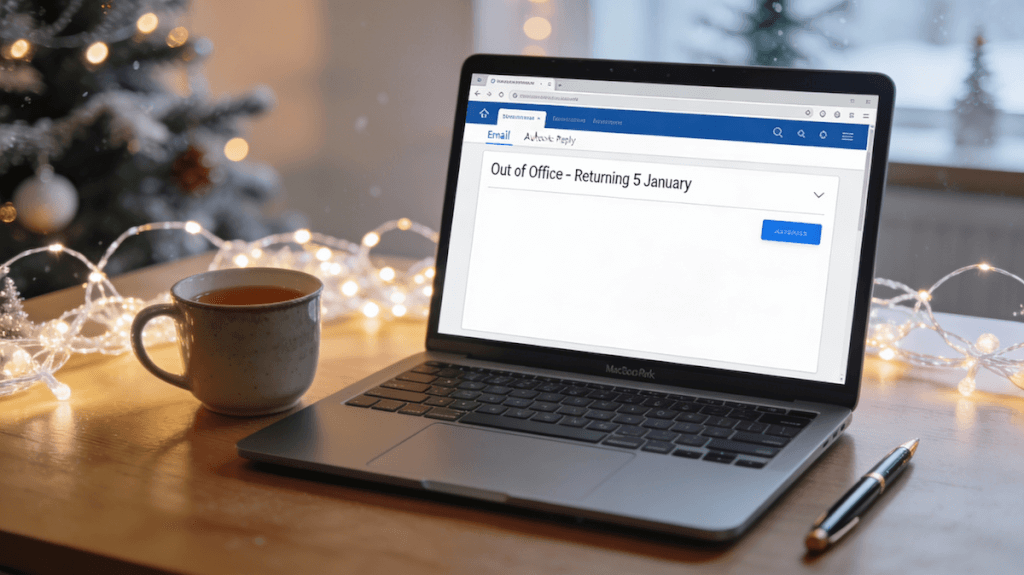
Many people finished work for Christmas last Friday 19 December 2025 and won’t be back until the New Year, with Monday 5 January 2026 being a popular restart date. Park the debate about business efficiency and productivity, I started thinking about the good and bad of Christmas out of office messages as replies to emails over the festive period.
Are they a helpful tool for managing expectations, or are they a security risk that tells the world you are not home?
The Bad: Security Risks and Missed Opportunities
Let’s start with the negatives. The worst offenders are those auto-responses that give away far too much personal information. I have seen messages that detail exactly where the person is going, for how long, and sometimes even the fact that their house will be empty. It is a security nightmare.
The Spam Trap
There is also a technical downside. As noted by tech writer Leo Notenboom, out of office replies can confirm your email address to spammers [1]. If a spammer sends a blanket email to thousands of addresses and your auto-responder fires back, you have just confirmed a live, active account. You might find your inbox heavier than usual in January.
The Dead End
Another bad practice is the digital dead end. This is the message that simply says “I am away” with no alternative contact details and no indication of a return date. It is helpful to no one. It frustrates clients and leaves prospects wondering if you are still in business. If you are a consultant, that silence can be expensive.
The Good: Marketing and Human Connection
However, when done correctly, Christmas out of office messages can be a subtle piece of marketing.
Humanising Your Brand
We often forget that B2B relationships are still person-to-person. A well-crafted message can build a social connection. Research by Michelle Gielan suggests that sharing a little humanity in your auto-responder can actually deepen business relationships [2]. Instead of a robotic “I am away,” a message that mentions you are “recharging with family” or “walking the dog in the winter hills” adds a layer of personality that clients appreciate.
The Soft Sell
You can also use this real estate to signpost helpful content. While you are eating mince pies, your auto-responder could be directing people to your best blog posts of the year or a useful white paper. It is a passive way to keep adding value even when the office lights are off. Strategists at companies like Quantanite argue that these replies are potential gold mines for lead generation if you are smart about the data [3].
Must Does and Don’t Dos
If you are setting up your message for the 19 December to 5 January break, keep it simple.
Do state clearly when you are back. “I return on Monday 5 January 2026” is perfect.
Do offer an alternative contact for genuine emergencies, but only if that person actually agreed to cover you.
Do check your grammar. Nothing ruins a professional reputation faster than a typo that repeats 500 times.
Don’t promise to reply “immediately” upon your return. You won’t. You will be deleting hundreds of newsletters.
Don’t include your mobile number unless you actually intend to answer it.
Don’t be boring. A little festive cheer goes a long way.
Christmas out of office messages are a functional necessity, but they don’t have to be dull. Use them to protect your time, but also to remind people that there is a human behind the email address.
References and Further Reading
[1] Out-of-Office Replies are Evil. https://askleo.com/out_-of-_office_replies_are_evil/
[2] Why You Should Put a Little More Thought into Your Out-of-Office Message. https://hbr.org/2013/06/why-you-should-put-a-little-mo
[3] 5 Steps That Will Make You Love ‘Out Of Office’ Replies. https://www.quantanite.com/blog/out-of-office-replies-sales-strategy/



Leave a Reply