I’ve seen countless tools and frameworks come and go. One that has stood the test of time, however, is the Business Model Canvas (BMC). It’s a tool that’s gained significant traction in the business world, particularly among startups and innovation-focused companies. But where did it come from, and is it the one-size-fits-all solution it’s often touted to be? In this post, I’ll explore the origins of the BMC, weigh its pros and cons, and consider where it might be most effectively applied.
The Birth of the Business Model Canvas
The Business Model Canvas didn’t just appear out of thin air. Its roots can be traced back to the doctoral work of Alexander Osterwalder at the University of Lausanne in Switzerland. Under the supervision of Professor Yves Pigneur, Osterwalder developed his thesis on business model ontology in 2004[1].
However, it wasn’t until 2008 that the Business Model Canvas as we know it today began to take shape. Osterwalder and Pigneur, along with a community of 470 practitioners from 45 countries, collaborated on refining the concept. This collaborative effort culminated in the 2010 publication of “Business Model Generation: A Handbook for Visionaries, Game Changers, and Challengers”[1].
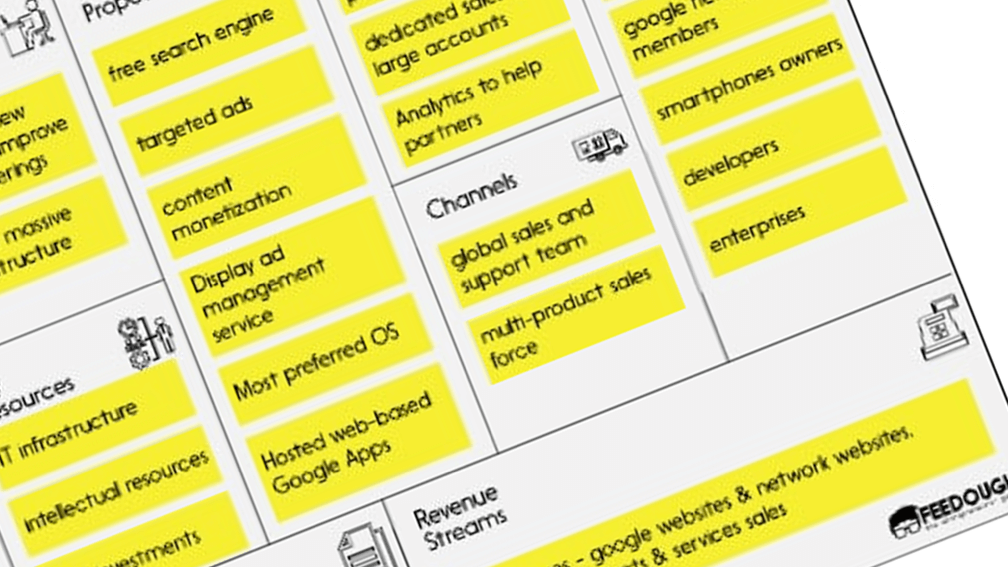
The book introduced the Business Model Canvas as a strategic management template for developing new or documenting existing business models. It’s essentially a visual chart with elements describing a firm’s or product’s value proposition, infrastructure, customers, and finances.
The Nine Building Blocks of the Business Model Canvas
At its core, the Business Model Canvas consists of nine key building blocks:
- Customer Segments
- Value Propositions
- Channels
- Customer Relationships
- Revenue Streams
- Key Resources
- Key Activities
- Key Partnerships
- Cost Structure
These nine elements are designed to provide a comprehensive overview of a business model on a single page. The idea is that by filling out each of these sections, entrepreneurs and business leaders can gain a holistic view of their business and how all the pieces fit together.
The Pros of the Business Model Canvas
Having used the Business Model Canvas in various contexts, I can attest to several of its strengths:
Simplicity and Clarity
One of the most significant advantages of the BMC is its simplicity. It distils complex business concepts into a single-page visual representation. This clarity can be invaluable when communicating your business model to team members, investors, or partners[4].
Holistic Perspective
The canvas encourages users to consider all aspects of their business simultaneously. This holistic view can help identify interdependencies and potential conflicts within the business model that might otherwise be overlooked[5].
Flexibility and Adaptability
The BMC is not a rigid framework. It can be adapted to suit different types of businesses and can be easily updated as your business evolves. This flexibility makes it a valuable tool for both startups and established companies looking to innovate[5].
Collaboration Tool
The visual nature of the canvas makes it an excellent tool for collaborative brainstorming sessions. It can facilitate discussions among team members and stakeholders, ensuring everyone is on the same page regarding the business model[5].
Strategic Focus
By forcing users to distil their business model into key components, the BMC helps maintain a strategic focus. It can prevent businesses from getting bogged down in unnecessary details and keep the focus on core value creation and delivery[4].
The Cons of the Business Model Canvas
Despite its popularity and widespread use, the Business Model Canvas is not without its critics. Here are some of the limitations I’ve observed:
Oversimplification
While simplicity is one of the BMC’s strengths, it can also be a weakness. Complex businesses with multiple revenue streams or intricate value chains may find the canvas too simplistic to capture all the nuances of their operations[4].
Lack of External Focus
The BMC primarily focuses on internal aspects of the business. It doesn’t explicitly account for external factors like market conditions, competitive landscape, or regulatory environment, which can be crucial for business success[5].
Static Nature
The canvas provides a snapshot of the business model at a particular point in time. It doesn’t inherently capture the dynamic nature of business or provide a clear path for evolution and growth[5].
Limited Financial Detail
While the BMC includes revenue streams and cost structure, it doesn’t provide a detailed financial analysis. For many businesses, especially those seeking investment, a more comprehensive financial model is necessary[5].
Potential for Misuse
Like any tool, the BMC can be misused. Some users may treat it as a checkbox exercise rather than a thoughtful analysis of their business model. This can lead to superficial insights and missed opportunities[4].
Ideal Applications of the Business Model Canvas
Given these pros and cons, it’s clear that the Business Model Canvas isn’t a one-size-fits-all solution. In my experience, it’s particularly well-suited to certain applications:
Startup Planning
For startups in the early stages of development, the BMC can be an excellent tool for clarifying and communicating the business concept. It forces founders to think through all aspects of their business and can help identify potential issues early on[6].
Innovation Workshops
Established companies looking to innovate can use the BMC in brainstorming sessions. It provides a structured framework for exploring new business models or adapting existing ones[6].
Strategic Alignment
The canvas can be a powerful tool for aligning teams around a shared understanding of the business model. It’s particularly useful in organisations where different departments may have divergent views of how the business operates[6].
Competitive Analysis
By mapping out competitors’ business models using the BMC, companies can gain insights into their strengths and weaknesses. This can inform strategic decision-making and help identify opportunities for differentiation[6].
Investor Pitches
While not a replacement for a full business plan, the BMC can be an effective way to quickly communicate the essence of a business model to potential investors. It provides a clear, concise overview that can be easily digested[6].
Beyond the Canvas: Complementary Tools and Approaches
While the Business Model Canvas is undoubtedly a valuable tool, it’s important to recognise that it’s not the only tool available, nor should it be used in isolation. Here are some complementary approaches that can enhance the use of the BMC:
Lean Canvas
Developed by Ash Maurya, the Lean Canvas is an adaptation of the Business Model Canvas specifically designed for startups. It places more emphasis on problem-solution fit and key metrics, which can be particularly relevant for early-stage ventures (https://leanstack.com/lean-canvas).
Value Proposition Canvas
Also developed by Osterwalder, the Value Proposition Canvas zooms in on two of the BMC’s building blocks: customer segments and value propositions. It provides a more detailed framework for ensuring that a product or service is positioned around what the customer values and needs (https://www.strategyzer.com/canvas/value-proposition-canvas).
SWOT Analysis
A SWOT (Strengths, Weaknesses, Opportunities, Threats) analysis can complement the BMC by providing a more explicit consideration of external factors. This can help address one of the key limitations of the canvas (https://www.mindtools.com/pages/article/newTMC_05.htm).
Business Model Environment Map
This tool, also from Osterwalder and Pigneur, helps analyse the context in which a business model evolves. It considers key trends, market forces, industry forces, and macroeconomic forces, providing a more comprehensive view of the external environment (https://www.strategyzer.com/library/your-business-model-environment).
My Take on the Business Model Canvas
Having used the Business Model Canvas in various contexts over the years, I’ve come to appreciate it as a valuable tool in the entrepreneur’s toolkit. However, I’ve also learned to recognise its limitations and to use it judiciously.
In my experience, the BMC shines brightest in the early stages of business planning and innovation workshops. It’s an excellent tool for getting ideas out of your head and onto paper in a structured format. It forces you to think through all aspects of your business model and can quickly highlight areas that need more thought or development.
However, I’ve also seen the BMC misused. Too often, I’ve encountered entrepreneurs who treat it as a magic bullet, believing that if they can just fill out all the boxes, they’ll have a successful business. This is far from the truth. The canvas is a starting point, not an endpoint.
I’ve found that the BMC is most effective when used in conjunction with other tools and approaches. For example, I often use it alongside a more detailed financial model, a comprehensive market analysis, and a thorough examination of the competitive landscape. The canvas provides the big picture, while these other tools fill in the crucial details.
Moreover, I always encourage users of the BMC to think beyond the nine boxes. What external factors might impact your business model? How might it need to evolve? What assumptions are you making, and how can you test them?
In essence, I see the Business Model Canvas as a powerful tool for structuring thoughts and facilitating discussions about business models. But like any tool, its effectiveness depends on how it’s used. It’s not a substitute for critical thinking, market research, or financial planning. Instead, it’s a complement to these activities, providing a framework for organising and communicating complex business concepts.
As we move forward in an increasingly complex and rapidly changing business environment, tools like the Business Model Canvas will continue to be valuable. But they’ll be most effective when used thoughtfully, in combination with other tools and approaches, and with a clear understanding of their strengths and limitations.
In the end, the Business Model Canvas is not a silver bullet, but rather a useful lens through which to view and analyse business models. When used wisely, it can be a powerful aid in business planning and innovation. But it’s just one tool in what should be a diverse and well-stocked entrepreneurial toolkit.
References and Further Reading
- Osterwalder, A., & Pigneur, Y. (2010). Business Model Generation: A Handbook for Visionaries, Game Changers, and Challengers. John Wiley & Sons.
- Strategyzer. (n.d.). The Business Model Canvas. https://www.strategyzer.com/canvas/business-model-canvas
- Blank, S. (2013). Why the Lean Start-Up Changes Everything. Harvard Business Review. https://hbr.org/2013/05/why-the-lean-start-up-changes-everything
- Creately. (n.d.). Business Model Canvas: Explained with Examples. https://creately.com/guides/business-model-canvas-explained/
- Inc42. (n.d.). Everything You Need To Know About Business Model Canvas. https://inc42.com/glossary/business-model-canvas/
- Bizzdesign. (n.d.). 7 Applications of the Business Model Canvas. https://bizzdesign.com/blog/7-applications-of-the-business-model-canvas/
- Maurya, A. (2012). Running Lean: Iterate from Plan A to a Plan That Works. O’Reilly Media.
- Ries, E. (2011). The Lean Startup: How Today’s Entrepreneurs Use Continuous Innovation to Create Radically Successful Businesses. Crown Business.
- Zig When Others Zag: The Power of Differentiation in Business Strategy




Leave a Reply