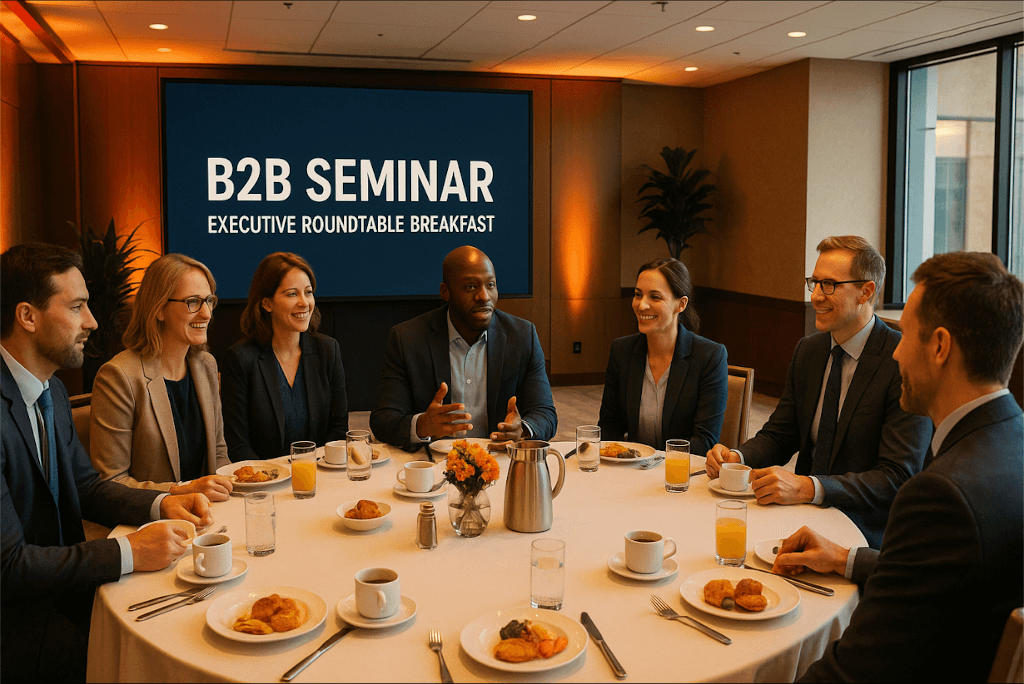
The classic invite-only seminar is no relic. Across the United Kingdom and beyond event planners report brisk demand for compact content-rich gatherings that pair great conversation with artisan coffee and a plate of pastries. Eighty-six percent of B2B marketers say they will host the same number or more in-person events in 2025 compared with 2024[1]. That appetite signals a fertile moment for marketers who value relationship-driven growth. In this post I unpack the history, share fresh data, and lay out a practical step-by-step guide to staging memorable invite-only B2B seminars that delight clients and prospects alike. My focus keyword throughout is invite-only B2B seminars.
Where We Came From
In the 1980s many UK financial advisers put weekly breakfast briefings on the calendar, offering bacon rolls and interest-rate forecasts in exchange for a business card. By the 1990s tech vendors copied the format, flying thought-leaders into Reading or Leeds to speak about fibre networks. Despite the digital boom those gatherings stayed popular because face-to-face stories from living clients trumped polished slide decks every time. The practice took a knock in 2020 yet by mid-2023 seventy-eight percent of organisers already ranked in-person events as their most effective marketing channel[2] and attendance continues to recover; only ten percent of planners now view audience decline as a permanent issue[2].
The State of Invite-Only Seminars in 2025
Current research paints a bullish picture. A Forrester survey of more than 200 event leaders found fifty-eight percent plan to run more small hosted events this year[3]. Bizzabo’s global study shows 60 percent of all events are back on site, 35 percent stay virtual and just 5 percent run hybrid[2]. Meanwhile UK venues logged their highest number of meetings in November 2023 and overall revenue per delegate climbed 12.19 percent year on year[4]. Experiential marketing spend worldwide is forecast to reach $50 billion in 2024[5], and B2B accounts for forty percent of that total[6]. In short, demand and budgets are aligned.
Which Sectors Still Count Seminars as Core?
Financial services, enterprise software and professional services remain the prime adopters because large lifetime values justify higher customer-acquisition costs. Cyber-security vendors, SaaS scale-ups and HR platforms also lean heavily on executive breakfasts for pipeline creation[7][8]. Industrial manufacturers employ plant-tour lunch-and-learns to reassure procurement teams, while private healthcare firms host compliance seminars for clinical commissioners. Across these verticals invite-only B2B seminars thrive wherever purchase decisions are complex, consultative and trust-sensitive.
Why In-Person Beats Pixels
Freeman data show 70 percent of attendees rate in-person events as the best source for professional learning[9]. Seventy-eight percent agree physical gatherings offer superior networking[10]. Although webinars remain plentiful, only 43 percent of registrants complete a thirty-minute session[11], yet 72 percent stay for a 90-minute in-room roundtable[12]. Humans still build trust most quickly over coffee and eye contact.
Crafting an Agenda That Works Now
In my own seminars I still open with a warm welcome, then run four core blocks:
- A high-energy market snapshot tying macro-trends to local impact.
- A client success story told by the client–peer-voice beats vendor-voice.
- A concisely framed product insight that solves the pain raised earlier.
- An open Q&A with roving microphone rather than rigid panel.
Freeman reports that 75 percent of delegates favour hands-on demos or participatory activities[2], so I weave in a live tool walkthrough using audience data. I also film short segments and loop QR codes so the room can download slides instantly.
Crowd Size: Small Is Still Beautiful
Roundtable specialists such as MyOutreach routinely cap attendance at 10-12 C-level guests for maximum intimacy[13]. LinkedIn moderators suggest 10-15 keeps discussion lively without losing focus[14]. Markletic’s data confirm 8-10 works best for structured roundtables[12]. For presentation-style breakfasts I recommend 25-40 participants – large enough for energy yet small enough for genuine conversation.
Duration and Flow
BBC Worklife research finds that forty-five minutes is the sweet spot for breakfast meetings before attention drifts[15]. I aim for sixty-five minutes total including Q&A. When hosting a midday seminar I stretch to ninety minutes but never longer than two hours. Virtual fatigue has trained audiences to value brevity[12] while travel costs press the same point.
Best Months, Days and Times
Event agency data place January, February, March, May, June, October and November as the most reliable UK months for B2B gatherings[16]. August is a washout and December risky unless the focus is festive. Thursday is statistically the most popular day with Wednesday a close second[17]. For breakfast seminars I open doors at 07:45, serve flat whites at 08:00, start content at 08:30 and finish by 09:35 so guests reach the office by 10:00. Evening seminars work on Tuesdays or Thursdays with a 17:00 arrival, 17:30 start and 19:15 finish – London trains thin after 21:00.
Location Matters
Central business districts draw higher RSVPs because commuters already flow there. The QEII Centre in Westminster told Business of Events that September 2023 was its highest revenue month ever, confirming appetite for city-centre venues[4]. Yet out-of-town settings can add novelty if transport is simple and parking ample. A converted barn within five miles of the M4 often beats a bland hotel two Tube changes away.
Food, Drink and Comfort
Breakfast meetings benefit from coffee quality above all else[18]. I hire local roasters who grind on site. A continental buffet with plenty of fruit keeps queues short and nutrition high[19]. For evening sessions craft beers or an English sparkling wine help networking but limit alcohol to one glass per person to maintain focus. Room temperature around 20 °C feels comfortable; anything above 24 °C prompts yawns.
Technology Trimmed to Fit
Audience engagement platforms such as Slido allow upvoting of questions without breaking flow. Artificial-intelligence tooling automates captioning, summarises transcripts and even drafts post-event reports – AI adoption for event productivity is the leading driver according to 59 percent of marketers surveyed by Statista[20]. QR badges speed check-in and help track dwell times for accurate ROI calculations.
Sustainability Signals
Clients increasingly expect greener choices. I swap printed agendas for a mobile microsite, supply keep-cups, choose venues reachable by train, and donate surplus pastries to local shelters within one mile at 20 mph by electric van. These gestures cut waste and broadcast values.
Calculating ROI Without Guesswork
Bizzabo says 52 percent of marketers already view events as the highest-ROI channel[21]. I tag every attendee in the CRM, add campaign codes to bookings, and run a twelve-month attribution model. Forrester notes 92 percent of planners now improve post-event follow-up to prove impact[3]. Timely calls, gated replays and personalised decks convert breakfast chat into pipeline.
My Step-by-Step Blueprint
- Clarify purpose and audience fit in writing.
- Reserve a venue with natural light and Wi-Fi tested at 100 Mbps.
- Invite current clients first–their presence validates promises.
- Send handcrafted email invites six weeks out, then a physical card at four weeks; response rates can treble when print follows digital[22].
- Publish a landing page that references the focus keyword invite-only B2B seminars in the title tag.
- Confirm speakers, rehearse stories, cut slide text to twelve words max.
- Finalise menus two weeks out (remember vegan croissants).
- Print badges on recycled stock seven days out.
- Go live, greet every guest at the door, guide them to seats by first name.
- Post-event, distribute a five-question survey the same day while memories stay fresh[23].
Frequently Asked Questions
How early should invitations go out?
Six to eight weeks gives busy executives room to block calendars yet not so long that diaries drift[24].
What percentage of no-shows is normal?
In my experience five to ten percent is typical. Double-confirm by SMS forty-eight hours before the event and the figure falls below five percent.
Should I charge for attendance?
For positioning purposes I rarely charge. The cost per attendee runs £95-£140 including venue and catering, but the pipeline generated often exceeds £40,000.
My Closing Thoughts
Invite-only B2B seminars remain a powerhouse when they respect time, spark learning and nurture trust. By blending concise content, lively discussion and sensory comfort you will create mornings that prospects recall long after the croissants are gone.
References and Further Reading
[1] The top trends and tactics for in-person events in 2024 – eMarketer https://www.emarketer.com/content/top-trends-tactics-in-person-events-2024
[2] The Events Industry’s Top Marketing Statistics, Trends, and Data https://www.bizzabo.com/blog/event-marketing-statistics
[3] The Global State of B2B Events – Forrester https://www.forrester.com/blogs/the-global-state-of-b2b-events-8-key-findings-from-the-forrester-2024-b2b-event-trends-survey/
[4] Upward trajectory for UK business events https://www.meetings-conventions-asia.com/News/Industry-Reports/Upward-trajectory-for-UK-business-events
[5] Experiential marketing spending worldwide 2019-2024 – Statista https://www.statista.com/statistics/1537289/experiential-marketing-spending/
[6] Top B2B Event Stats And Trends You Must Know In 2025 – OrangeOwl https://orangeowl.marketing/b2b-marketing-trends/b2b-event-stats-and-trends/
[7] Are in-person events worth it for B2B sellers and marketers in 2024? https://www.amplemarket.com/blog/are-in-person-events-still-worth-it-in-b2b-saas
[8] The Key Event & Conference Industry Trends to Watch in 2024 https://www.accliverpool.com/resources/the-key-event-conference-industry-trends-to-watch-in-2024/
[9] [PDF] 2024 Attendee Intent and Behavior – Freeman https://www.freeman.com/wp-content/uploads/2024/10/Freeman-Trends-Report-Attendee-Motivators-Jan-2024.pdf
[10] Bizzabo Releases Report on the State of In-person B2B Conferences https://www.exhibitoronline.com/news/article.asp?ID=23343
[11] 56 Webinar Statistics you Need to Know (New 2025 Report) https://www.getcontrast.io/learn/webinar-statistics
[12] 60 Incredible Virtual Event Statistics [2024 Research] – Markletic https://markletic.com/blog/virtual-event-statistics/
[13] Live Events | Executive Roundtables – MyOutreach https://www.my-outreach.com/live-events
[14] 3 Lessons I Learned Around the Executive Roundtable https://businesscollective.com/3-lessons-i-learned-around-the-executive-roundtable/index.html
[15] Breakfast is the real power hour for success – BBC https://www.bbc.com/worklife/article/20161027-breakfast-is-the-real-power-hour-for-success
[16] What’s the best time of year and best day to host an event? https://autumnlive.co.uk/whats-the-best-time-of-year-and-best-day-to-host-an-event/
[17] Discover the Best Day for Your Next Engaging Company Event https://www.epochapp.com/blog/discover-the-best-day-for-your-next-engaging-company-event
[18] Planning Successful Business Breakfast Events | 8 Top Tips https://blog.giggster.com/planning-successful-business-breakfast-events-8-top-tips/
[19] Breakfast meetings and why they rock – Parties To Go https://www.partiestogo.co.uk/2022/02/why-choose-breakfast-meetings/
[20] Top reasons for AI application in event marketing and webinars 2023 https://www.statista.com/statistics/1454320/reasons-ai-applied-event-marketing/
[21] Event Marketing Statistics 2023 – 99Firms https://99firms.com/blog/event-marketing-statistics/
[22] Client events – 13 tips to make your seminars more successful https://www.billbowden.co.uk/client-events-13-tips/
[23] Event Surveys: Helping You Plan For Greater Event Success https://www.smartsurvey.co.uk/blog/event-surveys-helping-you-plan-for-greater-event-success
[24] B2B Event Marketing Guide – The marketing plan, make it or break it https://emarketingstars.com/b2b-event-marketing-guide-the-marketing-plan-make-it-or-break-it/
>>> Dress Codes for Events in the UK



Leave a Reply