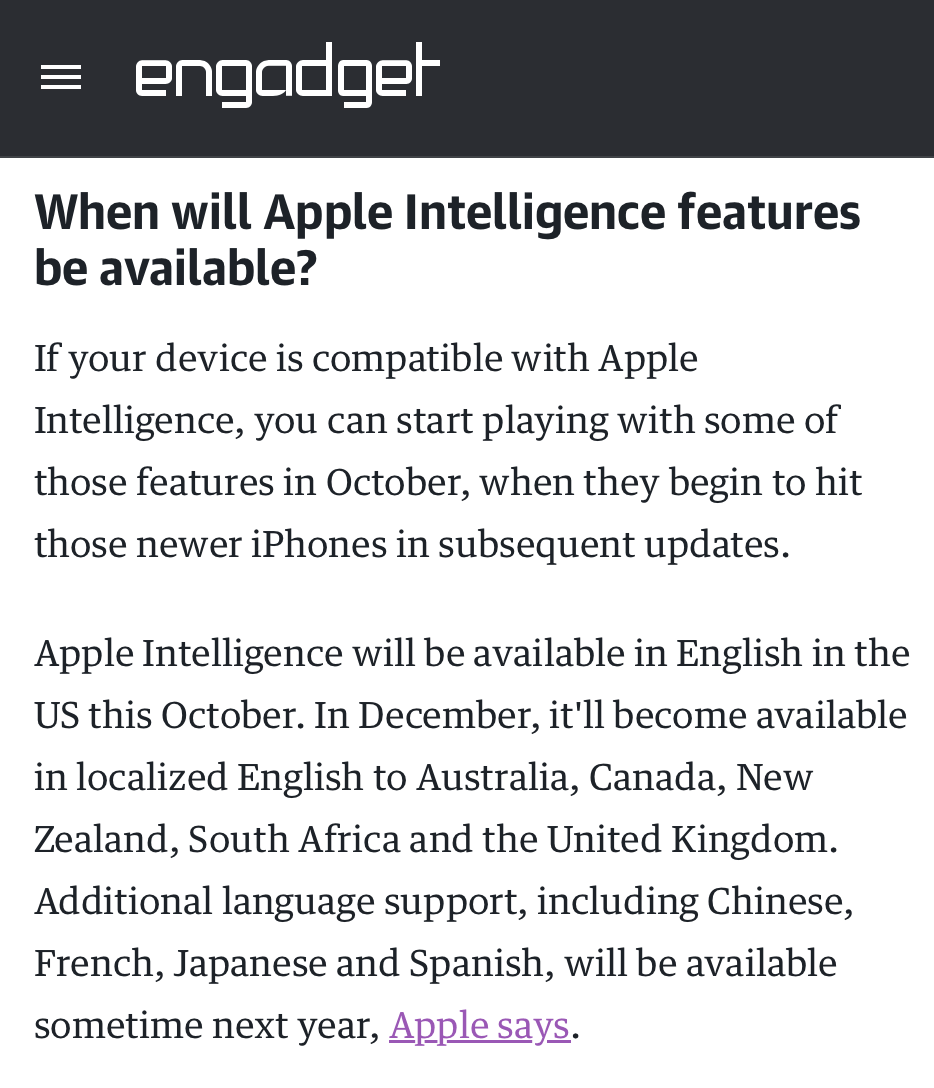
Apple’s recent announcement about the rollout of Apple Intelligence features has sparked an intriguing conversation about language and localisation. As a Brit, I find their approach to English rather amusing, if not slightly perplexing.
The Apple Intelligence Rollout
Apple has unveiled its plans for the release of Apple Intelligence features, and it’s quite the linguistic journey. According to their statement, these features will debut in October for compatible devices in the United States, using what they deem ‘standard’ English. However, it’s their next step that’s raised a few eyebrows on this side of the pond.
‘Localized’ English for the UK?
In an interesting twist, Apple has decided that the Queen’s English (or should I say the King’s English now?) needs a bit of localisation. Come December, Apple Intelligence will grace the shores of Australia, Canada, New Zealand, South Africa, and our very own United Kingdom with what they’re calling ‘localized English’.
The idea of ‘localizing’ a language in its country of origin does seem a tad ironic. It’s as if Apple has decided that American English is the default setting, and the rest of us English-speaking nations are mere variations on a theme.
The Linguistic Pecking Order
This approach seems to suggest a peculiar linguistic hierarchy in Apple’s worldview. American English takes the lead, with British English and its Commonwealth cousins following as localised versions. It’s an amusing concept, considering the long and rich history of the English language in these ‘localized’ regions.
Implications for Language and Technology
Apple’s stance raises some interesting questions about the relationship between language and technology. In an increasingly globalised world, how do tech giants navigate the nuances of language? Is this a case of Silicon Valley-centrism, or simply a practical approach to software rollout?
The Broader Picture
While it’s easy to chuckle at the idea of ‘localizing’ English for England, this situation highlights a broader issue in the tech world. As companies like Apple continue to shape our digital landscape, their decisions about language and localisation can have far-reaching effects on how we communicate and perceive linguistic differences.
What’s Next?
As we await the arrival of our ‘localized’ Apple Intelligence in December, one can’t help but wonder what other linguistic surprises might be in store. Will we need to ‘localize’ our tea-drinking habits or queue-forming techniques next?
In all seriousness, while Apple’s approach might seem a bit odd to us Brits, it’s a reminder of the complex interplay between technology, language, and culture in our modern world. As we move forward, it will be interesting to see how other tech companies handle these linguistic nuances.
For now, I suppose we’ll just have to embrace our ‘localized’ status and look forward to asking Siri for a ‘localised’ weather forecast. Who knows, maybe she’ll even learn to appreciate a good cup of tea.

Leave a Reply