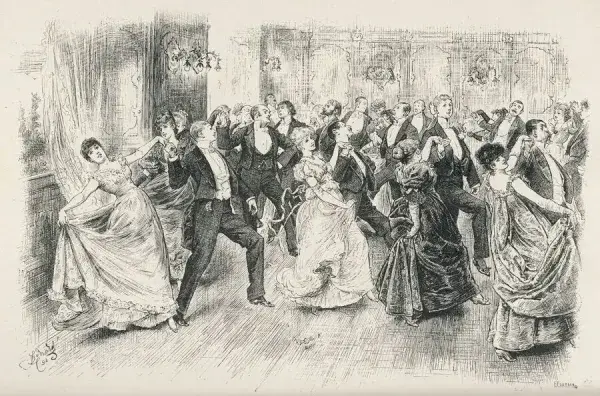
While many people might believe subscription-based entertainment began with digital platforms such as Napster, the roots of paid, recurring entertainment access stretch much further back in history. Long before music streaming, people engaged in subscription services to access books, theatre, and, notably, social dances. In the 18th and 19th centuries, models like subscription dances offered paying members entrance to multiple balls and events throughout the year, representing one of the earliest forms of entertainment subscription. This early system of regular payment for shared cultural experiences laid important groundwork for the subscription models that later revolutionised publishing, arts, and eventually digital entertainment.
A subscription dance was a formal social event in the 18th and 19th centuries where people purchased seasonal memberships or “subscriptions” to attend a series of balls and dances throughout the social season. This model represented an early form of the subscription economy that predates modern streaming services and subscription boxes by centuries.
Historical Context and Origins
The subscription model for social entertainment emerged as part of the broader subscription culture of the 17th and 18th centuries[1]. Originally, the term “subscribe” meant “to sign under” in a legal context, acknowledging consent to a scheme or document by putting money on the table[1]. By the 18th century, this concept had evolved to include various social and cultural activities.
Subscription dances were particularly prominent in England and its colonies, including America[2][3]. These events were sophisticated social occasions that served multiple purposes: networking, establishing business connections, and providing opportunities for young people to meet prospective marriage partners[4].
How Subscription Dances Worked
The Subscription Model
Participants purchased seasonal subscriptions that entitled them to attend multiple balls throughout the social season[5][4]. For example, at Bath’s New Assembly Rooms in England, a subscription to dress balls cost £1 10s (£1.50) and provided three admissions to each ball – one for the subscriber and two for ladies[4]. A single ticket subscription cost 15s (£0.75) but was non-transferable[4].
To put this in perspective, the average laborer in 1800 England earned just £12 per year, meaning a full subscription represented over 12% of their annual income[4]. This pricing effectively restricted attendance to the middle and upper classes, despite being theoretically “open to the public”[5][4].
Organisation and Venues
Subscription dances were typically held in public ballrooms rather than private homes[5]. Popular venues included assembly rooms in cities like Bath, or elegant hotels like those in London’s Grosvenor Square or Portland Place[6]. The events were organised by social leaders who formed committees to manage the series[5][2].
In colonial America, similar arrangements existed. Richmond, Virginia established the Richmond Assemblies as a series of subscription balls when it became the new state capital[7]. These events helped establish and maintain the social fabric of colonial elite society.
Social Significance and Protocol
Class and Social Structure
Subscription dances served as important venues for maintaining and displaying social status[4]. While attendance was based on ability to pay rather than inherited titles, strict social protocols governed interactions. Masters of Ceremony decided who could dance with whom, ensuring that social boundaries remained intact even in these mixed-class environments[8].
Etiquette and Conduct
These events followed elaborate protocols[9][10]. Guests were expected to dress formally; ladies in evening gowns and gentlemen in suits or formal evening wear[9]. Strict behavioural codes governed everything from arrival times to dance partner selection, with emphasis on politeness, courtesy, and proper social conduct[9].
The balls typically opened with formal dances like minuets, performed by couples in order of social precedence[11]. This would be followed by country dances and other social dances[11][6]. Dancing continued well into the early morning hours, often lasting until 4 or 5 AM[11].
Cultural Impact and Legacy
Fundraising and Community Purpose
Beyond pure entertainment, subscription balls often served charitable purposes[12]. They were frequently organised to raise money for local hospitals, fire brigades, or other community needs[12]. This dual purpose of social entertainment and civic engagement made them important community institutions.
Geographic Spread
The subscription dance model spread throughout the British Empire and former colonies. Australia developed its own tradition of subscription balls on the goldfields, where they served as opportunities to display newfound wealth and maintain social connections in frontier communities[12].
Evolution and Decline
The subscription dance tradition gradually evolved and eventually declined as social customs changed. By the early 20th century, the format had transformed into various forms of club dances and private parties[13]. The rise of more informal social entertainment and changing class structures contributed to the eventual disappearance of the formal subscription dance model.
Modern Parallels
The subscription dance represents an early example of the subscription economy model that dominates many modern businesses. Just as 18th-century socialites purchased seasonal access to a series of entertainment events, today’s consumers subscribe to streaming services, fitness classes, and other recurring services[14][15]. The fundamental appeal remains similar: predictable access to desired experiences through regular payments, creating ongoing relationships between providers and consumers.
The subscription dance tradition demonstrates how social entertainment has long relied on community investment and shared financial commitment to create sustainable cultural institutions, a principle that continues to influence how we organise and consume entertainment today.
Reference and Further Reading
[1] The surprising early history of the subscription model – LinkedIn https://www.linkedin.com/pulse/surprising-early-history-subscription-model-ajay-jain
[2] Subscription Ball History – Bush Music Club Inc. https://www.bushmusic.org.au/ball_history.shtml
[3] A French Subscription Ball in 1801: A Popular Diversion https://www.geriwalton.com/a-french-subscription-ball-in-1801/
[4] Social Dancing – a matter of import | The Historic Interpreter https://historicinterpreter.wordpress.com/2014/12/08/social-dancing-a-matter-of-import/
[5] Subscription Dances. – Chest of Books https://chestofbooks.com/society/Household-Companion/The-Home-Book-Of-Etiquette/Subscription-Dances.html
[6] A Selection of Balls from 1810 – Regency Dances Org https://www.regencydances.org/paper050.php
[7] Dance during the Colonial Period – Encyclopedia Virginia https://encyclopediavirginia.org/entries/dance-during-the-colonial-period/
[8] Ballroom Etiquette | Mending My Own Pen – WordPress.com https://austenette.wordpress.com/2008/09/20/ballroom-etiquette/
[9] Ballroom etiquette ⋆ UMNITS https://umnits.org/en/ballroom-etiquette/
[10] The Etiquette of the Victorian Ballroom: Twenty Tips for Single … https://www.mimimatthews.com/2017/05/08/the-etiquette-of-the-victorian-ballroom-twenty-tips-for-single-gentlemen/
[11] Going to the Ball – Dance in History https://danceinhistory.com/2015/05/22/going-to-the-ball/
[12] Subscription Balls | State Library of New South Wales https://www2.sl.nsw.gov.au/archive/discover_collections/history_nation/gold/miners_life/balls/index.html
[13] Dance Etiquette – Part 1 – 1920-30 https://www.1920-30.com/dance/dance-etiquette.html
[14] SUBSCRIPTION Definition & Meaning – Dictionary.com https://www.dictionary.com/browse/subscription
[15] How the Streaming Service Subscription Model Is Evolving https://www.clintstinchcomb.com/latest-post/how-the-streaming-service-subscription-model-is-evolving



Leave a Reply