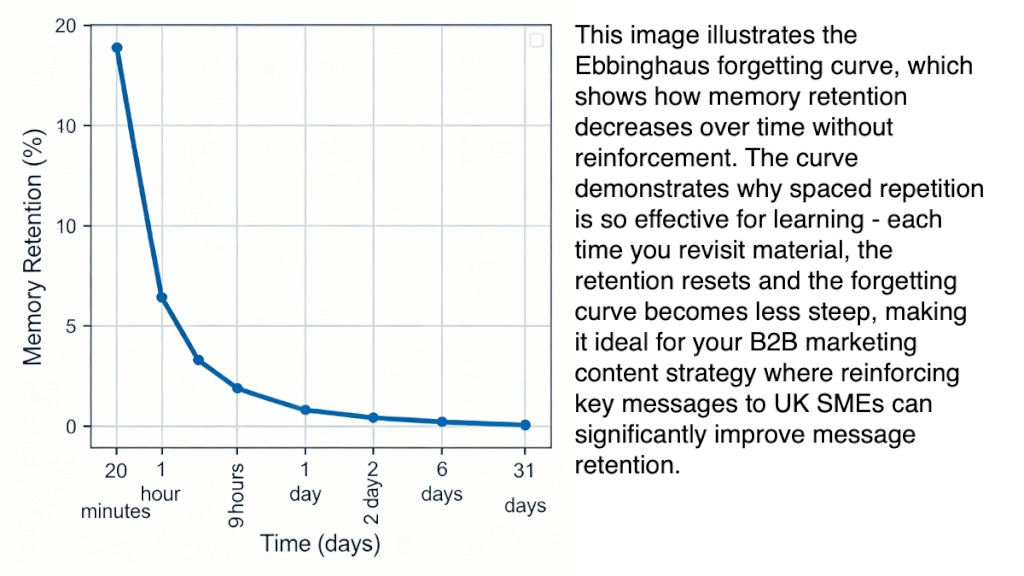
When I first encountered the Ebbinghaus memory retention curve in my marketing research, it struck me how profoundly it explains why so many B2B campaigns fail to gain traction. The science is simple yet sobering: without reinforcement, your prospects forget about 50% of your message within a day and up to 90% within a month.
For UK SME marketers working with limited budgets (58% spend less than £250 per month on marketing according to the SME Marketing Report 2025), understanding the Ebbinghaus memory retention curve isn’t just academic curiosity. It’s the difference between marketing that works and money down the drain.
The Memory Gap in B2B Marketing
The B2B buying journey is notoriously complex. Research from Laire Digital shows buyers may touch your brand over 50 times before contracting, involving multiple decision-makers across extended evaluation cycles. Yet here’s the problem: if prospects forget 75% of your marketing content within 24 hours, as studies cited by Revela Advisors indicate, you’re essentially starting from scratch with each interaction.
The challenge is particularly acute for SMEs. Research from the Chartered Institute of Marketing highlights that 46% of UK SMEs don’t have a formal marketing strategy, and 65% of marketing activities are managed by business owners themselves. Without a systematic approach to memory reinforcement, your valuable insights and compelling propositions simply evaporate from prospect minds.
Understanding the Ebbinghaus Memory Retention Curve
The forgetting curve describes how quickly we lose information without active reinforcement. After learning something new, retention drops exponentially. The curve is steepest in the first hours and days, then gradually levels off, though what remains after a week is only a small fraction of the original information.
The mathematical relationship, expressed as (R = e^{-t/S}), where (R) represents memory retention, (t) is time elapsed, and (S) is memory strength, reveals that forgetting follows a predictable pattern. But here’s the encouraging part: each time you reinforce that information through spaced repetition, you flatten the curve and strengthen long-term retention.
Several factors influence how quickly prospects forget your message. Meaningful content connected to their existing knowledge and pain points is retained longer than generic messaging. Sleep plays a surprisingly important role, providing observable memory consolidation that creates brief plateaus in the forgetting curve. Stress and cognitive overload accelerate forgetting, which is why bombarding prospects with information rarely works.
What This Means for B2B Marketers
The implications for B2B marketing strategy are profound and practical. First, the Rule of Seven isn’t just folklore. It takes an average of seven interactions with your brand before a prospect takes action because each exposure reinforces fading memories. Research from DataHQ confirms that people forget 60% of information within 20 minutes and 90% within a week unless you make intentional attempts to refresh it.
Second, content frequency matters more than most marketers realise. According to Advant Technology’s research, optimal B2B advertising frequency varies by channel: LinkedIn sponsored content performs best at 3-5 impressions per week for awareness campaigns, whilst retargeting works at 5-8 impressions per month. The key is sustained engagement without causing ad fatigue.
Third, the timing of your follow-up content is critical. Ebbinghaus’s research shows that repeating information at strategic intervals (the spacing effect) dramatically improves retention. Information learned and partially forgotten is more strongly retained when re-encountered than information maintained through continuous exposure.
Practical Strategies for SME B2B Marketers
Given these insights, how should you structure your B2B marketing to combat the forgetting curve? Start with spaced repetition in your content calendar. Instead of the “big bang” approach where you concentrate all activity into a short campaign period, spread your touchpoints strategically over weeks and months. The Financial Times’ research demonstrates that campaigns using spaced repetition can increase brand recall to 50-55% even after 30 days, compared to just 10% for one-off messages.
Develop a multi-channel reinforcement strategy. Don’t rely on a single channel to carry your message. Research from RAIN Group shows it takes an average of eight touchpoints to secure an initial meeting, with top performers achieving this with five. Use email, LinkedIn, your website, retargeting ads, and sales calls in coordination to reinforce the same core messages from different angles.
Create meaningful, memorable content. The Ebbinghaus curve shows that meaningful information connected to existing knowledge is forgotten more slowly. For your SME prospects, this means addressing their specific pain points, using familiar frameworks, and connecting your solutions to challenges they already understand. CX Today’s research confirms that storytelling, emotional connections, and personalised interactions significantly enhance memory retention.
Build a lead nurturing sequence. After someone downloads your content or attends your webinar, don’t let them disappear into the void. According to Richardson’s studies, within 30 days of a learning event, 79% of information is forgotten. Create a structured sequence that reinforces your key messages at strategic intervals: within 24 hours, at three days, at one week, at two weeks, and at one month.
Use consistent branding and messaging. Research on brand building shows that spacing out exposure over time is more effective than repeated exposure in a shorter period. But consistency is crucial. Keep your core message, visual identity, and value proposition constant across touchpoints so each exposure reinforces rather than contradicts the previous one.
Measure and optimise. Track which touchpoints generate engagement and conversions. HubSpot’s research suggests that whilst eight touchpoints is average, your specific audience may need more or fewer. Monitor your data to find your optimal frequency and spacing, adjusting based on click-through rates, conversion rates, and engagement metrics.
Making Memory Work for Your Marketing
The Ebbinghaus memory retention curve reveals an uncomfortable truth: most of your marketing effort is forgotten almost immediately. But it also provides the solution. By understanding how memory works and designing your campaigns around spaced repetition, meaningful content, and multi-channel reinforcement, you transform fleeting impressions into lasting brand recall.
For UK SME B2B marketers, this isn’t about spending more. It’s about spending smarter. Instead of one expensive event or campaign that’s forgotten within days, spread that investment across multiple touchpoints timed to reinforce memory at critical intervals. Make each piece of content work harder by repurposing it across channels. Build systems that ensure prospects encounter your message repeatedly in varied, valuable ways.
The forgetting curve is predictable. That means it’s beatable. The question isn’t whether your prospects will forget you, it’s whether you’ll be there to remind them when it matters most.
The Science Behind the Ebbinghaus Memory Retention Curve
The Ebbinghaus memory retention curve, developed by German psychologist Hermann Ebbinghaus in 1885 through groundbreaking experiments on his own memory, remains one of psychology’s most influential discoveries. Ebbinghaus’s research involved memorising lists of nonsense syllables and testing his recall at various intervals, meticulously documenting how information degraded over time.
His findings revealed a mathematical relationship between time and memory retention. Without any attempt to retain information, recall follows an exponential decay function. The curve shows that forgetting happens most rapidly immediately after learning. Within the first hour, approximately 50% of new information is lost. By 24 hours, retention drops to roughly 34%, and within a week, only about 10% of the original information remains accessible.
However, Ebbinghaus discovered something equally important: the curve could be flattened through repetition. Each time information is reviewed or recalled, the rate of forgetting decreases. This “overlearning effect” means that spaced repetition, where information is revisited at increasing intervals, dramatically improves long-term retention compared to massed practice.
Modern neuroscience has validated and expanded Ebbinghaus’s work. Studies published in PLOS ONE replicated the forgetting curve with contemporary subjects, confirming its accuracy whilst identifying additional factors that influence memory retention. Sleep consolidation, emotional valence, prior knowledge integration, and the distinctiveness of information all modulate the rate of forgetting.
The spacing effect, a related phenomenon, explains why distributed practice outperforms cramming. Research on the spacing effect shows that when learning sessions are spaced over time, the brain is forced to work harder to retrieve information, strengthening neural pathways and improving long-term storage. This effortful retrieval during spaced repetition creates stronger, more accessible memories than passive re-exposure.
For practical application, the mathematical formula (R = e^{-t/S}) provides a framework for understanding memory decay, where (R) represents retrievability (the likelihood of successful recall), (t) is the time elapsed since learning, and (S) represents the strength of the memory trace. The strength factor (S) increases with each successful retrieval, explaining why spaced repetition progressively improves retention.
Contemporary applications of the Ebbinghaus curve extend far beyond academic psychology. Educational systems use spaced repetition algorithms in learning apps. Sales training programmes structure reinforcement sessions around the forgetting curve to improve knowledge retention. Marketing strategists leverage the spacing effect to design campaigns that maximise brand recall whilst minimising advertising fatigue.
The curve’s implications are particularly relevant in today’s information-saturated environment. Recent research shows attention spans have fallen from 75 seconds in 2015 to just 47 seconds in 2025, whilst daily marketing message exposure has jumped from 3,000 to more than 5,200 per day. In this context, understanding and applying the Ebbinghaus curve isn’t optional for effective marketing, it’s essential for breaking through the noise and creating lasting mental availability with your target audience.
References and Further Reading
[1] What is The Forgetting Curve? Definition, History & Key Strategies. https://www.growthengineering.co.uk/forgetting-curve/
[2] Forgetting curve – Wikipedia. https://en.wikipedia.org/wiki/Forgetting_curve
[3] Ebbinghaus’s Forgetting Curve: How to Overcome It – Whatfix. https://whatfix.com/blog/ebbinghaus-forgetting-curve/
[4] What is the Ebbinghaus Forgetting Curve? How to Boost Memory. https://cloudassess.com/blog/ebbinghaus-forgetting-curve/
[5] What is the Ebbinghaus forgetting curve? A Complete Guide. https://www.talentcards.com/blog/ebbinghaus-forgetting-curve/
[6] Replication and Analysis of Ebbinghaus’ Forgetting Curve – PMC – NIH. https://pmc.ncbi.nlm.nih.gov/articles/PMC4492928/
[7] Rethinking Consumer Engagement in the AI Era. https://revelaadvisors.com/the-forgetting-curve-revolution-rethinking-consumer-engagement-in-the-ai-era/
[8] Unlocking the Secrets to Memory Retention in Customer Experience. https://www.cxtoday.com/contact-center/unlocking-the-secrets-to-memory-retention-in-customer-experience-15-tips-that-work/
[9] Epic Win: The #1 Spaced Repetition Marketing Powerhouse. https://vbscenes.com/power-of-spaced-repetition-marketing-and-social-proof/
[10] How to avoid your marketing plan from being filed and forgotten. https://datahq.co.uk/ideas-library/blog/ways-to-avoid-your-marketing-plan-from-brts-Integrated-Marketing/



Leave a Reply