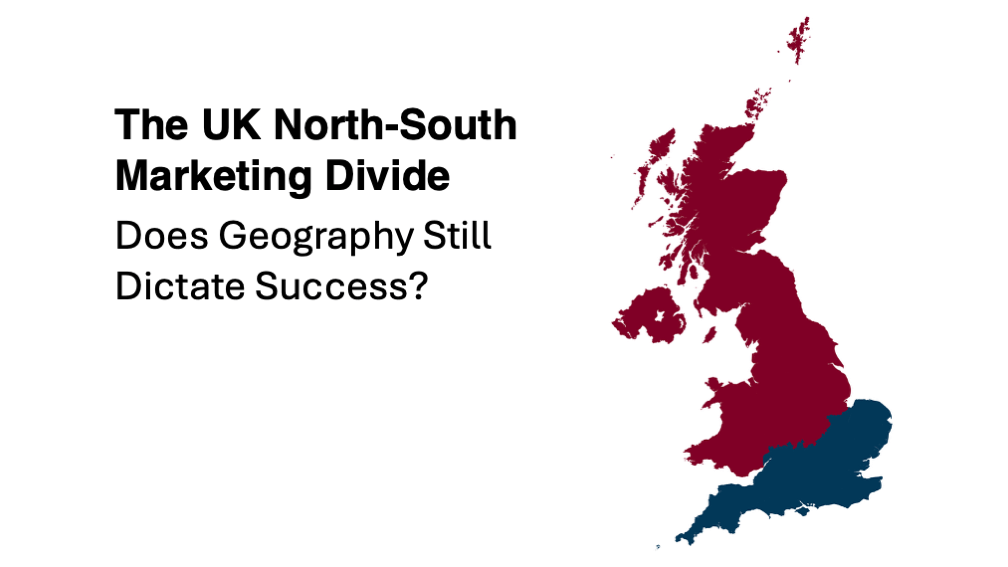
Does Geography Still Dictate Success?
Right, let’s get straight into this thorny subject that’s been causing heated debates in marketing circles for decades. The UK’s north-south divide isn’t just about accents, house prices, or which end of the country gets the decent weather – it’s fundamentally reshaping how we think about marketing, advertising, and consumer behaviour in 2025.
I’ve spent the better part of my career watching this divide evolve from a simple London-versus-everywhere-else narrative into something far more complex and, frankly, more interesting. The question isn’t whether the north-south marketing divide exists – it absolutely does. The real questions are whether it matters, who benefits, who gets left behind, and what this all means for brands, agencies, and consumers across the country.
The State of Play in 2025
Let me paint you a picture of where we stand today. The north-south divide in marketing isn’t just about where agencies happen to be based anymore. It’s about economic realities, consumer behaviours, talent distribution, and fundamentally different approaches to how brands connect with people.
The numbers tell a compelling story. London continues to dominate UK advertising spend, with the capital and South East maintaining their stranglehold on the industry’s financial muscle[1]. In 2024, UK advertising spend reached £40.7 billion, with the lion’s share concentrated in the south[2]. Yet here’s where it gets interesting – the north is experiencing unprecedented growth in house prices, with regions like the North East seeing 5.2% year-on-year increases, nearly double London’s rate[3].
This economic shift is creating new opportunities and challenges that traditional north-south thinking simply can’t address. The North West is leading job vacancy growth in technology at 17.5%[4], while the North East is seeing a massive 22.4% surge in industrial and engineering roles[4]. These aren’t the rust belt regions of popular imagination – they’re becoming economic powerhouses in their own right.
Why the Divide Matters More Than Ever
From a consumer perspective, the north-south divide has never been more relevant. Recent research reveals that 35% of people across the UK don’t think their local area is represented well in advertising, but this jumps to 43% in Wales, 41% in the East Midlands, and 40% in Scotland[5]. Meanwhile, only 20% of Londoners feel their area isn’t properly represented[5].
This isn’t just about hurt feelings or regional pride. It’s about brands missing massive commercial opportunities. When 41% of consumers feel that brands misuse local cues, they’re essentially telling us that our industry is failing at one of marketing’s most basic functions – understanding your audience[5].
The spending patterns tell an even more revealing story. In 2023, households in South East England spent £612.40 per week compared to the UK average of £526[6]. But the North East, with the lowest spending at around £340 per week, also has the most affordable housing market with a median price-to-earnings ratio of just 4.9 compared to England and Wales average of 8.14[3].
What does this mean? Northern consumers might have less absolute spending power, but they have significantly more disposable income relative to their cost of living. They’re not a secondary market – they’re a different market entirely, with different priorities, different pressures, and different opportunities.
The Agency Perspective: London’s Grip Loosens
Here’s where things get really interesting from an agency standpoint. The traditional model of London agencies charging premium rates for supposed superior creative and strategic thinking is under serious pressure. Northern agencies aren’t just competing anymore – they’re winning.
Leeds alone hosts agencies like SuperSonic, Northern Artillery, Onstate, Engage, Sun Branding, and Tall, each consistently proving that postcode doesn’t determine creative excellence[7]. Manchester’s digital marketing scene is thriving, with the city embracing technology and innovation in ways that rival anything coming out of Shoreditch[8].
The cost advantage is undeniable. Northern agencies can offer the same quality of work at significantly lower overheads. A Digital Marketing Manager in London commands £60,000-£70,000, while their counterpart in the North East earns £45,833-£62,500[9]. That’s not just savings for the agency – that’s savings they can pass on to clients while maintaining healthy margins.
But here’s what really matters: these aren’t just cheaper versions of London agencies. They’re bringing different perspectives, different cultural insights, and different solutions to marketing challenges. When M3.agency in Birmingham hit £2 million in annual revenue and started expanding their team by 20% year-on-year[10], they weren’t just succeeding – they were proving that Birmingham’s marketing talent can compete with anyone.
The Brand Dilemma: Where to Invest Your Marketing Pounds
For brands, the north-south divide presents both challenges and opportunities that would have been unthinkable a decade ago. The traditional approach of launching everything in London, testing in Manchester, and hoping it works everywhere else is looking increasingly outdated.
Consumer behaviour during the cost-of-living crisis perfectly illustrates why brands need to think regionally. While London consumers maintained relatively high consumption levels, northern consumers made more dramatic reductions in spending, but they also showed different patterns of brand loyalty and value-seeking behaviour[11].
This isn’t about northern consumers being less valuable – it’s about them being differently valuable. They’re more likely to stick with brands that understand their local context, more responsive to authentic community connections, and more forgiving of brands that make genuine efforts to connect with their regional culture.
The danger for brands is treating the north-south divide as an afterthought. When 52% of consumers believe brands should represent the values of communities and locations in their content[5], but so many brands default to London-centric thinking, they’re missing opportunities to build deeper, more meaningful relationships.
The Consumer Experience: Feeling Seen vs Feeling Stereotyped
From a consumer perspective, the marketing divide often feels like being talked at rather than talked to. I’ve seen too many campaigns that use northern imagery or accents as shorthand for “authentic” or “down-to-earth” without understanding the nuanced realities of regional consumer behaviour.
Northern consumers aren’t just Londoners with different accents. They have different shopping patterns, different media consumption habits, and different relationships with brands. The data shows that 57% of non-Londoners feel advertising is too London-focused, and 48% believe people in the industry don’t understand them[12].
But here’s the opportunity: consumers who feel their location is accurately represented are more likely to find advertising helpful for product discovery and to enjoy creative, engaging content[5]. This isn’t about pandering to regional stereotypes – it’s about genuine understanding and authentic connection.
The most successful brands are those that recognise regional differences without making them the entire story. They understand that a consumer in Newcastle might have different priorities from someone in Brighton, but they’re still seeking quality, value, and brands that align with their values.
Technology: The Great Leveller
One of the most significant changes in recent years has been how technology has democratised marketing excellence. Remote working, digital collaboration tools, and cloud-based creative platforms mean that geographical location matters less than it ever has before.
A Manchester-based agency can collaborate with clients in real-time just as effectively as a London agency can. Screen sharing, video calls, and project management platforms have removed many of the traditional advantages of being in the same city as your clients[13].
This technological levelling has been particularly beneficial for northern agencies. They can access the same tools, the same data, and the same global best practices as their southern counterparts, but with significantly lower overheads and often deeper local market knowledge.
The result is that clients are increasingly choosing agencies based on capability and cultural fit rather than postcode. When remote working became the norm, it eliminated one of London’s last genuine advantages – the presumed need for face-to-face meetings.
The Talent Migration Story
Here’s where the narrative gets really interesting. For decades, the story was simple: ambitious marketing professionals moved to London for the best opportunities, highest salaries, and most prestigious clients. That’s changing, and changing fast.
The data shows that 25% of marketing teams are set to expand in 2025, with budget increases across digital, content and event-based spending[9]. But this growth isn’t concentrated in London anymore. Northern cities are becoming talent magnets in their own right.
Manchester’s marketing scene is attracting professionals who want the career opportunities of a major city without the crushing cost of living that comes with London[8]. Leeds agencies are reporting record turnovers and expanding teams[14]. Birmingham’s digital marketing sector is experiencing 20% year-on-year growth[10].
This isn’t brain drain in reverse – it’s brain circulation. Talented marketers are discovering they can have fulfilling careers, work on interesting challenges, and maintain a better quality of life outside London. For agencies, this means access to experienced professionals who might have been priced out of the London market.
Regional Specialisation: Playing to Strengths
One of the most encouraging developments is seeing northern agencies and cities play to their genuine strengths rather than trying to replicate London. Manchester is becoming a hub for digital innovation and technology marketing[8]. Leeds is developing expertise in financial services and professional services marketing[14]. Birmingham is building a reputation for integrated marketing communications[10].
This specialisation benefits everyone. Brands get access to agencies with deep sector knowledge and regional expertise. Agencies can command premium rates for specialist knowledge rather than competing purely on cost. And consumers get marketing that reflects genuine understanding of their local context and culture.
The key is that this isn’t about northern agencies trying to be London agencies with cheaper rent. It’s about recognising that different regions offer different advantages and building on those strengths.
The Investment Picture: Where the Money Follows
Follow the money, and you’ll see where the real opportunities lie. While London continues to dominate absolute advertising spend, the growth rates tell a different story. Northern regions are seeing faster growth in property values, employment, and consumer confidence in key sectors[3][4].
For brands, this means reassessing where they allocate marketing budgets. A pound spent on marketing in Manchester might generate different returns than a pound spent in London, not necessarily because the audience is better or worse, but because the competitive landscape and cost structures are different.
The smart money is recognising these regional differences and planning accordingly. Rather than treating the UK as a single market with London as the default, forward-thinking brands are developing truly regional strategies that acknowledge different opportunities and challenges in different parts of the country.
Cultural Authenticity vs Marketing Authenticity
Here’s where things get tricky. The north-south divide in marketing isn’t just about economics or logistics – it’s about culture. And culture can’t be faked or manufactured through research and focus groups.
Northern consumers can spot inauthentic “northern” marketing from miles away. Using a Manchester accent in a voiceover or showing cobbled streets doesn’t constitute regional marketing any more than showing Big Ben constitutes London marketing. It’s lazy, patronising, and ultimately counterproductive.
The agencies that succeed in this environment are those that understand regional culture from the inside. They’re not trying to decode the north for southern clients – they’re northern agencies serving northern markets with southern-standard creativity and strategic thinking.
This cultural authenticity becomes a competitive advantage that can’t be easily replicated. A Leeds agency understands Yorkshire culture not because they’ve researched it, but because they live it. That understanding shows up in everything from campaign concepts to media planning to community engagement.
The Future of Regional Marketing
Looking ahead, I believe we’re moving towards a more sophisticated understanding of regional marketing that goes beyond the traditional north-south divide. The UK market is becoming more nuanced, with city-regions developing their own distinct identities and consumer behaviours.
Manchester is different from Liverpool, which is different from Leeds, which is different from Newcastle. London is different from Brighton, which is different from Bristol. The successful brands and agencies of the future will be those that understand these nuances and can operate effectively across multiple regional markets.
Technology will continue to level the playing field, but it won’t eliminate the importance of cultural understanding and local market knowledge. If anything, as digital channels become more crowded and expensive, local knowledge and authentic regional connections will become more valuable.
The agencies that thrive will be those that combine technological sophistication with deep local roots. They’ll be able to execute complex digital campaigns while understanding the cultural nuances that make them effective in specific regional markets.
Who Benefits and Who Loses
In this evolving landscape, the winners and losers aren’t simply divided along north-south lines. The winners are brands that embrace regional complexity, agencies that build genuine local expertise, and consumers who benefit from more relevant, authentic marketing.
The losers are brands that stick to outdated London-centric thinking, agencies that compete purely on cost without developing distinctive capabilities, and consumers who continue to be served poorly targeted, culturally tone-deaf marketing.
Northern agencies that simply position themselves as “cheaper than London” without developing genuine competitive advantages will struggle. Southern agencies that rely on postcode prestige without delivering superior results will find themselves increasingly vulnerable.
The brands that win will be those that develop sophisticated regional strategies, work with agencies that understand local markets deeply, and create marketing that genuinely resonates with regional audiences without resorting to stereotypes or clichés.
Personal Reflections on a Changing Industry
Having worked across both sides of this divide throughout my career, I’ve seen how the relationship between north and south has evolved. The old model of London setting the agenda and everywhere else following is broken, probably irreparably.
What’s replacing it is more interesting and more complex. It’s a network of regional centres of excellence, each with their own strengths, specialisations, and perspectives. This isn’t a zero-sum game where northern success means southern decline – it’s an expansion of opportunity and capability across the entire country.
The marketing industry is stronger when it draws on diverse perspectives, different cultural insights, and varied approaches to creative and strategic challenges. The north-south divide, rather than being a problem to solve, might actually be an asset to leverage.
The Road Ahead
The UK north-south marketing divide in 2025 is real, significant, and evolving rapidly. It’s not going anywhere, but it’s becoming more sophisticated and more nuanced than the simple London-versus-everywhere-else narrative of previous decades.
For consumers, this means better, more relevant marketing that understands regional differences without patronising regional audiences. For brands, it means opportunities to build deeper connections with diverse markets across the country. For agencies, it means the chance to compete on genuine capability rather than geographical accident.
The divide matters because it reflects real differences in how people live, work, and consume across the UK. It’s relevant because these differences create distinct opportunities and challenges that generic, one-size-fits-all marketing simply can’t address effectively.
The brands, agencies, and marketers who embrace this complexity rather than fighting it will be the ones who thrive in the years ahead. The north-south divide isn’t a barrier to overcome – it’s a reality to understand, respect, and leverage for better marketing outcomes.
Whether you’re building campaigns in Birmingham, crafting strategies in Sheffield, or developing brand platforms in Brighton, the key is understanding that geography still matters in marketing. Not because of outdated stereotypes or regional prejudices, but because place shapes culture, culture shapes behaviour, and behaviour drives business results.
The UK marketing industry’s future lies not in eliminating regional differences, but in celebrating and leveraging them to create more effective, more authentic, and more successful marketing for everyone involved.
References and Further Reading
[1] UK Advertising Reports £108BN Spend in Q2 2024 https://www.ukaop.org/hub/uk-advertising-reports-108bn-spend-in-q2-2024
[2] UK ad spend rose 9.7% to £10.6bn in Q3 2024 https://adassoc.org.uk/credos/uk-ad-spend-rose-9-7-to-10-6bn-in-q3-2024/
[3] North East Property Market 2025: Strong Growth, Buyer Demand … https://michaelpoole.co.uk/blog/north-east-property-market-2025-strong-growth-buyer-demand-changing-trends/43418
[4] Northern England – UK Regional Labour Market Trends, October … https://vacancysoft.com/northern-england-uk-regional-labour-market-trends-october-2024/
[5] Advertising failing to take account of regional differences in UK https://www.warc.com/content/feed/advertising-failing-to-take-account-of-regional-differences-in-uk/10485
[6] Average weekly household expenditure in the UK 2023, by region https://www.statista.com/statistics/379928/uk-household-expenditure-by-region/
[7] The London agency myth: Why brands can now get everything they … https://www.prolificnorth.co.uk/feature/the-london-agency-myth-why-brands-can-now-get-everything-they-need-in-the-north/
[8] Marketing in Manchester: A city of vibrant opportunities | Tempt https://temptmarketing.co.uk/marketing-in-manchester-a-city-of-vibrant-opportunities/
[9] Marketing Salary Guide 2025 – Ashdown Group https://www.ashdowngroup.com/salary-guide/marketing
[10] M3.agency toasts Birmingham life as second city office passes £2m … https://colmorebusinessdistrict.com/2025/02/m3-agency-birmingham/
[11] How the north-south divide is playing out in cost of living crisis https://www.thegrocer.co.uk/comment-and-opinion/how-the-north-south-divide-is-playing-out-in-cost-of-living-crisis/678377.article
[12] London or local: Has the hard-to-shift stigma of ‘local’ talent run its … https://weareborne.com/2024/02/07/london-or-local-agency/
[13] The digital agency North-South divide | Manchester SEO agency https://www.pixelkicks.co.uk/xpress/digital-agency-north-south-divide-choose-manchester-over-london/
[14] Leeds marketing agency makes raft of promotions and appointments … https://bdaily.co.uk/articles/2024/02/29/leeds-marketing-agency-makes-raft-of-promotions-and-appointments-to-aid-growth
[15] The north-south divide – Internet Geography https://www.internetgeography.net/topics/the-north-south-divide/
Image Source
This is the credit for the North South Divide in the United Kingdom:
Adam Hegazy337259, CC BY-SA 4.0 https://creativecommons.org/licenses/by-sa/4.0, via Wikimedia Commons



Leave a Reply