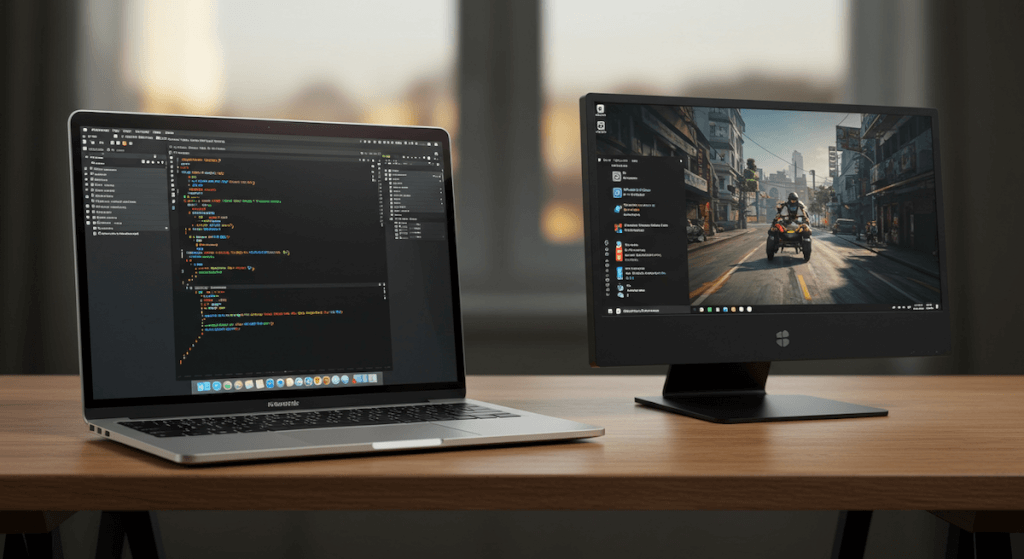
I’ve always been intrigued by the age-old tech debate that seems to split creative and marketing professionals down the middle. Back in the day, you could spot a marketing agency from a mile off – row upon row of sleek iMacs and MacBooks, their glowing Apple logos acting like badges of creative honour. But here I am in 2025, wondering whether this picture has changed. Are Macs still the go-to choice for UK marketing professionals, or has the landscape shifted towards a more balanced approach?
The Current State of Play: Numbers Don’t Lie
Let me start with some hard facts that might surprise you. Apple has actually grown its market share significantly in recent years[1]. Globally, Mac computers now hold 10.2% of the PC market as of Q4 2024, with Apple being the fastest-growing vendor among the top manufacturers[1]. In the US specifically, macOS commands an impressive 29.62% of the desktop operating system market[2][3].
But here’s where it gets interesting for us marketing folk. When businesses give their employees a choice between Mac and PC, a staggering 72% opt for Mac[4]. That’s not just preference talking – that’s a clear signal that professionals see real value in the Apple ecosystem.
The UK creative industries, which include a substantial chunk of marketing and advertising professionals, now employ 2.4 million people and contribute £124.6 billion to the economy[5][6]. Within this landscape, the digital marketing industry alone employs over 1.5 million people[7]. These aren’t small numbers we’re talking about.
Marketing Professionals: Still Team Mac?
From my research into current industry practices, the answer appears to be a resounding “yes” – though perhaps not as universally as before. One particularly telling piece of research found that 70% of creative professionals still prefer Mac for their reliability and software compatibility[8].
This preference extends beyond just personal choice. Many UK marketing agencies have built their entire IT infrastructure around Apple products. Specialised IT support companies like Viewdata report having “over 50 creative companies” as clients, specifically catering to Mac-dominated environments[9][10]. These agencies understand that “Creative user’s needs are different from most IT users”[10].
The trend becomes even more pronounced when we look at specific creative roles. Research shows that UK professionals working in media, marketing, advertising, public relations, and sales are most likely to have a positive impression of the Mac brand, with 45% holding favourable views[11]. This is significantly higher than other sectors like hospitality and leisure (36%) or IT and telecoms (30%).
How Does This Compare to Other Professions?
The divide becomes stark when we compare marketing professionals to other industries. In general business environments, Windows still dominates with approximately 68.27% global market share[12]. The reasons are primarily economic – Windows laptops average between $500-$1,200, whilst MacBooks start from $999 and can easily exceed $2,500[12].
For professions where cost-efficiency trumps creative capability, PCs remain the practical choice. General business users, accountants, logistics professionals, and many corporate roles still gravitate towards Windows-based systems. The broader software compatibility, lower initial costs, and easier IT management make PCs attractive for bulk corporate purchases[13][14].
However, there’s a notable exception emerging in professional services. Studies indicate that when professionals are given the choice, preference patterns shift dramatically. In higher education, for instance, 71% of students prefer Mac, with 83% of current Mac users wanting to continue using Mac when entering the workforce[15].
The Image and Cachet Factor: Still Strong
Let’s be honest about something that marketing professionals understand better than most – brand perception matters enormously. Apple has masterfully maintained Mac computers as symbols of creativity and professional sophistication. The MacBook Air is described as “an ideal travel companion and, given its sleek styling and Apple’s cachet, a bit of a status symbol”[16].
This isn’t just superficial positioning. Apple’s “Behind the Mac” campaign specifically targets creative professionals, featuring respected artists and emphasising how Mac computers enable creative work[17]. The campaign strategically links Apple’s brand image to creativity itself, making Mac ownership feel like membership in an exclusive creative community.
The psychological aspect runs deeper than simple brand preference. Research indicates that exposure to Apple branding actually improves performance on creative tasks[18]. When people see Apple advertising, they unconsciously adopt more creative mindsets. For marketing professionals whose work depends on creative thinking, this psychological priming effect represents genuine professional value.
Apple’s pricing strategy also reinforces this premium positioning. By maintaining higher price points, Apple ensures Mac ownership signals professional success and commitment to quality tools. It’s what marketers call “masstige” – mass prestige that makes premium products accessible to successful professionals whilst maintaining exclusivity[19].
Performance: Do Macs Still Deliver for Marketers?
Here’s where the conversation gets technical, and the results might surprise you. For core marketing applications, particularly Adobe Creative Suite, Macs continue to demonstrate superior performance[20][21]. Adobe has historically optimised their creative applications for macOS first, with Windows versions often lagging behind in performance and feature rollouts[22][20].
The introduction of Apple Silicon (M1, M2, M3, and M4 chips) has dramatically widened this performance gap. Adobe’s own benchmark tests showed Photoshop running 80% faster on M1 chips compared to previous Intel-based Macs[21]. This performance advantage extends across the entire Creative Cloud suite, including Illustrator, InDesign, Premiere Pro, and After Effects.
For video editing specifically, the performance comparison reveals interesting nuances. In Premiere Pro, Macs excel with intraframe codecs like ProRes, which are commonly used in professional video production[23]. However, for GPU-intensive effects and RAW processing, high-end Windows workstations with powerful NVIDIA graphics cards can outperform even the most expensive MacBook Pro[23].
The real-world implications for marketing professionals are significant. If your work involves graphic design, photo editing, or standard video production, Mac computers offer demonstrably better performance and stability. But if you’re doing complex motion graphics or working with AI-powered video effects, Windows workstations might provide better value.
Software Ecosystem: Mac’s Continued Advantage
Adobe Creative Suite remains the cornerstone of most marketing workflows, and this is where Mac’s advantages become most apparent. Beyond just performance, Macs offer superior integration with creative applications. Features like Universal Clipboard (copying content on iPhone and pasting on Mac), AirDrop for instant file sharing, and seamless syncing between devices create efficiency gains that accumulate throughout the workday[24].
Many specialised creative applications remain Mac-exclusive or Mac-optimised. Sketch, still widely used for UI/UX design, runs only on macOS[24]. Final Cut Pro and Motion provide professional video editing capabilities that are deeply integrated with Mac hardware. Logic Pro offers sophisticated audio editing that many content creators rely upon.
The software ecosystem extends beyond Adobe. Mac versions of applications often receive updates first and tend to be more stable[24]. Browser extensions, productivity tools, and AI-powered marketing applications frequently launch on Mac before Windows versions become available.
Economic Considerations: Total Cost of Ownership
Whilst Mac computers require higher initial investment, the total cost of ownership often favours Apple products for marketing professionals. Macs typically last longer, require less maintenance, and retain higher resale values[14][25]. For professionals who depend on reliable equipment, the reduced downtime and support costs can offset the higher purchase price.
Marketing agencies report that Mac-based workflows require less IT support and experience fewer compatibility issues[14][10]. When creative work operates on tight deadlines, system reliability becomes worth significant premium costs.
However, for larger marketing teams or agencies operating on tight budgets, the 30-40% cost difference between comparable Mac and PC systems remains substantial[26]. Many agencies adopt hybrid approaches, providing Macs for creative roles whilst using PCs for administrative and account management positions.
The Hybrid Reality of Modern Marketing Teams
Today’s marketing agencies increasingly operate hybrid IT environments. Creative professionals use Macs, whilst project managers, account executives, and administrative staff work on PCs. This approach balances creative requirements with economic realities.
Cloud-based collaboration tools like Google Workspace, Slack, and project management platforms work equally well across both platforms, making mixed environments more viable than ever before. Marketing teams can maintain creative Mac workflows whilst leveraging cost-effective PC systems for non-creative roles.
Future Trends: AI and Cross-Platform Integration
Artificial intelligence is reshaping marketing workflows, and both Mac and PC platforms are adapting rapidly. Apple’s M-series chips include dedicated Neural Processing Units optimised for AI tasks[1]. Meanwhile, Windows PCs are introducing “Copilot+ PC” standards with enhanced AI capabilities[27].
For marketing professionals, AI integration affects content creation, data analysis, and customer insights. Currently, many AI marketing tools work equally well on both platforms, though Mac versions often receive earlier access to new features.
The Verdict: Professional Choice Still Favours Mac
After examining current market data, professional preferences, and performance comparisons, Mac computers continue to dominate among UK marketing professionals. The combination of superior creative software performance, ecosystem integration, brand cachet, and professional community preference maintains Mac’s position as the preferred choice.
However, the landscape has become more nuanced. Smart marketing agencies now adopt strategic approaches based on role requirements rather than universal platform choices. Creative roles benefit significantly from Mac advantages, whilst administrative and analytical roles can achieve similar productivity with cost-effective PC alternatives.
For individual marketing professionals, the choice often comes down to career focus. If your work centres on creative content production, design, or video editing, Mac computers offer tangible performance and workflow advantages that justify their premium cost. If your role emphasises strategy, analytics, or project management, either platform can serve effectively.
The Mac vs PC divide in marketing reflects broader changes in our industry. We’ve moved from universal creative tools to specialised workflow optimisation. The most successful marketing professionals choose platforms that enhance their specific contributions rather than following industry-wide conventions.
As I reflect on this evolution, it strikes me that the real change isn’t in which computers marketing professionals prefer – it’s in how thoughtfully we now approach technology decisions. The days of choosing Mac simply because “that’s what creative people use” have given way to strategic platform selection based on actual workflow requirements.
This maturity in technology choice reflects the broader sophistication of our industry. Modern marketing demands diverse skills from creative production to data analysis to strategic planning. Our technology choices should reflect this diversity rather than adhering to outdated stereotypes about creative versus analytical work.
The Mac remains king among UK marketing professionals, but it now shares the kingdom more graciously with strategically chosen alternatives. That feels like progress to me.
References and Further Reading
[1] Mac market share growing faster than top three PC brands – 9to5Mac https://9to5mac.com/2025/02/26/mac-market-share-growing-faster-than-top-three-pc-brands-apple-leads-in-ai/
[2] How Many People Use MacOS? [Important MacOS Stats For 2025] https://www.spyhunter.com/shm/macos-stats/
[3] The Best Options for Designers and Developers in 2024 – Intelligraph https://www.theintelligraph.com/article/laptops-for-creators:-the-best-options-for-designers-and-developers-in-2024
[4] Apple gains ground as PC market heads into rocky 2025 https://appleinsider.com/articles/25/04/08/apple-gains-ground-as-pc-market-heads-into-rocky-2025
[5] Effective Marketing Strategies with the Apple MacBook https://www.marketdatacentre.com/effective-marketing-strategies-with-the-apple-macbook-path-to-competitive-advantage/
[6] Best Computers for Graphic Design 2024: Top Picks for Creatives – HP https://www.hp.com/us-en/shop/tech-takes/best-computers-for-graphic-design
[7] MacOS Market Share in the US Plummets 27% in 2024 as Windows … https://focusonbusiness.eu/en/news/macos-market-share-in-the-us-plummets-27-in-2024-as-windows-gains-13/6340
[8] Apple Statistics (2025) – Business of Apps https://www.businessofapps.com/data/apple-statistics/
[9] Best Computer for Adobe Creative Cloud 2024 https://www.agitraining.com/adobe/creative-cloud-classes/best-computer-adobe-creative-cloud
[10] The top 5 PC vendors globally (by market share) for 2024 – Techloy https://www.techloy.com/the-top-5-pc-vendors-globally-by-market-share-for-2024-2/
[11] How MacBook Is Transforming The Marketing Landscape – ReVerb https://reverbico.com/blog/how-macbook-is-transforming-the-marketing-landscape/
[12] Global PC shipments grew 3.9% to 256 million in 2024 – Canalys https://canalys.com/newsroom/global-pc-shipments-q4-2024
[13] Apple Statistics — Users, Devices, and Revenue (2025) – Backlinko https://backlinko.com/apple-statistics
[14] Why Digital Marketers Prefer Mac Over Windows in 2025 https://cubecreative.design/blog/partners/mac-vs-windows-digital-marketing-1904
[15] Key Findings – GOV.UK https://www.gov.uk/government/statistics/creative-industries-2016-focus-on/key-findings
[16] Windows or Mac: Which is Right for Digital Marketer https://www.almondsolutions.com/blog/windows-or-mac-which-is-right-for-digital-marketer
[17] UK Digital Creative industries – Where code meets culture https://thedatacity.com/blog/uk-digital-creative-industries-where-code-meets-culture/
[18] How Does Mac Compare To Windows For Digital Marketing? https://alexpodgurski.com/how-does-mac-compare-to-windows-for-digital-marketing/
[19] MacBook Vs Windows Laptop Statistics (2025) – ElectroIQ https://electroiq.com/stats/macbook-vs-windows-laptop-statistics/
[20] Creative industries employment 14% above pre-pandemic level https://www.thecreativeindustries.co.uk/facts-figures/creative-industries-employment-14-above-pre-pandemic-level
[21] Mac vs. PC: Which Is Best for a Marketing Agency? – AgencyAnalytics https://agencyanalytics.com/blog/mac-vs-pc-for-agencies
[22] Mac vs PC in 2024: Which One Is Right for You? – System Plus https://system.plus/2024/10/23/mac-vs-pc-in-2024/
[23] Mac vs Windows PC for Business: Is Now the Time to Adopt Macs? https://drlogic.com/article/mac-vs-windows-pc-for-business/
[24] [PDF] Future of Professionals Report 2024 | Thomson Reuters https://www.thomsonreuters.com/content/dam/ewp-m/documents/thomsonreuters/en/pdf/reports/future-of-professionals-report-2024.pdf
[25] New Research Finds 71% of Students in Higher Education Today … https://www.jamf.com/resources/press-releases/new-research-finds-71-of-students-in-higher-education-today-use-or-would-prefer-to-use-mac/
[26] [PDF] A Study of Brand Preference: An Experiential View https://bura.brunel.ac.uk/bitstream/2438/7542/1/FulltextThesis.pdf
[27] 2024 Stack Overflow Developer Survey https://survey.stackoverflow.co/2024/
[28] How Many People Use MacOS? [MacOS Statistics 2023] – TechJury https://techjury.net/industry-analysis/macos-statistics/



Leave a Reply