Picture a marketer in 2025 stepping into a coffee shop for a client meeting. They set down a sleek, minimalist bag (not quite the traditional briefcase of old) and pull out a laptop, smartphone, wireless earbuds, and perhaps a tablet. The physical briefcase itself has evolved dramatically, but what’s inside tells an even more fascinating story about how marketing has transformed over the past five decades.
The 2025 Marketing Toolkit
Today’s marketing professional carries what would have seemed like science fiction in 1975. The modern briefcase contains primarily digital devices and cloud-connected tools that provide instant access to global markets[1][2]. At the heart of this toolkit sits a laptop, typically a MacBook or high-specification Windows machine, loaded with AI-powered marketing platforms like ChatGPT, Jasper AI, and HubSpot[1][3].
The smartphone has become arguably the most essential tool, providing constant connectivity to social media platforms, email marketing systems, and real-time analytics dashboards[4]. Marketing professionals in 2025 rely on mobile apps for everything from managing advertising campaigns on Google and Meta platforms to scheduling social media content with tools like Blaze[3]. Push notifications alert them to campaign performance changes, customer inquiries, and market shifts throughout the day.
Inside the digital ecosystem, marketers access sophisticated platforms like Semrush for competitive analysis, Salesforce Einstein for predictive analytics, and Sprout Social for social media management[1][2]. These AI-powered tools analyse vast amounts of consumer data, predict buying behaviour, and automate routine marketing tasks that once consumed hours of manual work[3]. The ability to segment audiences, personalise content, and optimise campaigns happens in real time, with insights delivered directly to devices that fit in a pocket[1][2].
What’s notably absent from the 2025 briefcase are physical materials. Gone are printed brochures, sample advertisements, and bulky presentation materials. Everything exists in the cloud, accessible from any device, anywhere in the world. Marketing professionals can share entire campaigns, analytics reports, and creative assets with a simple link or QR code[2][5].
The Year 2000: Bridging Analogue and Digital
Wind the clock back to the year 2000, and the marketing briefcase told a different story. This was a transitional period when the digital revolution was underway but physical materials still dominated professional life[6][7]. Marketers carried laptop computers, though these were considerably heavier and less powerful than today’s models. The laptop served primarily for creating presentations in PowerPoint and managing email through programmes like Microsoft Outlook[7][8].
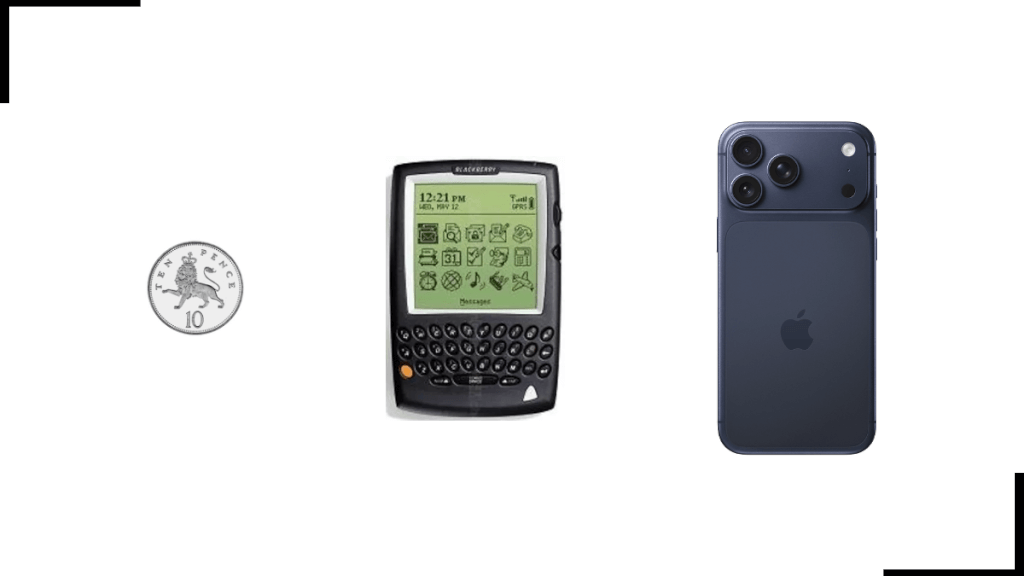
The breakthrough device of this era was the BlackBerry, which revolutionised professional communication by enabling wireless email access on the go[9]. Described as technology that “enables continuous connectivity without the necessity of actual conversation,” the BlackBerry allowed marketers to respond to emails almost instantly from any location[9]. Approximately one million Americans were using wireless email services by 2000, with BlackBerry leading the charge[9].
Physical materials remained essential. Marketers still carried printed portfolios showcasing past campaign work, bound reports with marketing plans, and CD-ROMs containing multimedia presentations[7]. Business cards were indispensable networking tools, exchanged at every meeting. USB drives became crucial for transferring large files, as broadband internet was not yet universal[4].
Marketing automation platforms like Eloqua and ExactTarget had launched by this time, but adoption was limited[7][8]. Most email marketing required significant manual work, and the sophisticated segmentation and personalisation we take for granted today were in their infancy[10]. The first Gmail accounts wouldn’t appear until 2004, and the iPhone that would transform mobile marketing was still seven years away[11][4].
1975: The Mad Men Era Briefcase
Travel back to 1975, and the marketing professional’s briefcase contained an entirely different world. This was the height of what many consider the golden age of advertising, an era immortalised in the television series Mad Men[12][13]. The physical briefcase itself, typically crafted from leather with brass fittings, was a status symbol that conveyed professionalism and authority[14].
Inside, marketers carried hand-drawn sketches and storyboards for advertising campaigns, created using rulers, Exacto knives, rubber cement, and typesetting sheets[15]. Every creative concept began on paper, meticulously crafted by hand before being photographed and turned into slides for presentation[15]. A Kodak Carousel slide projector, introduced in the early 1960s, had become the essential presentation tool by 1975[16][15]. Marketers would arrive at client meetings with circular slide trays containing 80 or 140 individual 35mm slides, each placed upside down and backwards so the image would project correctly[16].
Print advertisements, carefully mounted in leather-bound portfolios, showcased previous work[17]. These physical samples represented weeks or months of creative effort by advertising agencies. Television commercials existed on film reels or videotape, requiring specialised equipment to view. The first video cassette recorders had just been introduced in 1975, but they remained expensive and uncommon[18][19].
Marketers carried typed letters on company letterhead, carbon copies for records, and substantial amounts of printed market research data[20]. Telephone numbers and contact information lived in physical address books or on business cards filed in leather-bound organisers[8]. The ACT! (Automated Contact Tracking) system, one of the pioneering CRM tools, wouldn’t arrive until the 1980s, so all customer relationship management happened on paper[8].
Communication tools included coins for payphones when away from the office. Mobile phones existed in 1975 but were car-mounted devices used almost exclusively in vehicles, not the portable communication tools we know today[4]. The notion of checking email whilst travelling, let alone managing an entire marketing campaign from a coffee shop, belonged firmly in the realm of science fiction.
The Transformation of Marketing Work
Comparing these three snapshots reveals how fundamentally marketing work has changed. In 1975, marketing was largely a creative and interpersonal profession, focused on crafting compelling narratives for mass media channels like television, radio, and print[20][12]. Success depended on creative brilliance, understanding of human psychology, and relationships with media buyers and clients[13].
By 2000, marketing had become increasingly data-driven, but technology served primarily to enhance existing practices rather than transform them entirely[6][7]. Email marketing, early website analytics, and database management began shifting marketing from art towards science, though the balance still favoured traditional approaches[8][10].
Today’s marketing in 2025 represents a complete transformation. Artificial intelligence analyses consumer behaviour patterns at scales impossible for humans to comprehend[1][3]. Marketing has evolved from broadcasting messages to mass audiences to delivering hyper-personalised content to individuals based on their specific interests, behaviours, and predicted needs[2][3]. The marketing professional’s role has shifted from creative visionary to a hybrid of data analyst, technology specialist, and strategic storyteller[21][22].
The physical briefcase, once a symbol of professional authority, has largely given way to lightweight backpacks or messenger bags designed to distribute weight evenly and accommodate multiple digital devices[23]. A 2025 survey revealed that 68 percent of professionals now prefer backpacks over briefcases for daily work commutes, reflecting the shift towards mobility and the increasing weight of technology equipment[23].
What Remains Constant
Despite these profound changes, certain fundamentals endure. Whether in 1975, 2000, or 2025, successful marketers carry tools that enable them to understand their audience, craft compelling messages, and measure results[1][12][22]. The medium has shifted from print advertisements and television commercials to social media posts and targeted digital advertising, but the core objective remains unchanged: connecting products and services with the people who need them.
Creativity still matters, perhaps now more than ever in an attention-scarce digital environment[21][22]. The ability to tell authentic stories that resonate emotionally with audiences remains as crucial in 2025 as it was in the golden age of Madison Avenue advertising[22]. Technology amplifies human creativity rather than replacing it, providing tools to test ideas, measure impact, and iterate rapidly in ways the Mad Men generation could never have imagined.
The marketing briefcase, whether leather-bound in 1975, laptop-laden in 2000, or cloud-connected in 2025, ultimately represents the same thing: a professional’s readiness to understand their market, communicate value, and drive business results. What we carry has changed dramatically, but why we carry it connects marketing professionals across the decades in a shared mission to connect, persuade and grow.
References and Further Reading
- Top AI tools for digital marketers in 2025
- The Top 10 Marketing Tools to Build Your Tech Stack in 2025
- AI Will Shape the Future of Marketing
- Sony Says Goodbye To Betamax Tapes, How Marketing Has Changed From 1975-2016
- The real ads of the Mad Men era
- Marketing through the ages: The 1970s heralded an era of change
- The History of Email and Its Impact on Communication
- Marketing Automation History and Timeline Through The Years
- The Evolution of Marketing Automation: Its History Timeline and Future
- E-Mail You Can’t Outrun
- The Evolution of Digital Marketing: 30 Years in the Past & Future
- Before PowerPoint: The Evolution of Presentations
- The highs and lows of 1970s advertising
- The best adverts of the 1970s
- Briefcase or Backpack: The Modern Professional Dilemma
Sources
[1] Top AI tools for digital marketers in 2025 https://www.click.co.uk/insights/top-ai-tools-for-digital-marketers-in-2025/
[2] The Top 10 Marketing Tools to Build Your Tech Stack in 2025 https://www.jasper.ai/blog/the-top-10-marketing-tools-to-build-your-tech-stack-in-2025
[3] AI Will Shape the Future of Marketing https://professional.dce.harvard.edu/blog/ai-will-shape-the-future-of-marketing/
[4] The Evolution of Digital Marketing: 30 Years in the Past & https://digitalmarketinginstitute.com/blog/the-evolution-of-digital-marketing-30-years-in-the-past-and-future
[5] 26 best AI marketing tools I’m using to get ahead in 2025 https://www.marketermilk.com/blog/ai-marketing-tools
[6] Marketing through the ages: The 2000s bring the dilemmas … https://www.marketingweek.com/marketing-through-the-ages-2000s-dilemmas-digital/
[7] Marketing Automation History and Timeline Through The … https://thecmo.com/marketing-operations/marketing-automation-history/
[8] The Evolution of Marketing Automation: Its History … https://marketing-automation.ca/en-ca/blog/the-evolution-of-marketing-automation-its-history-timeline-and-future/
[9] E-Mail You Can’t Outrun https://www.nytimes.com/2000/09/21/technology/email-you-canacutet-outrun.html
[10] The History of Email Marketing https://knak.com/blog/history-of-email-marketing/
[11] The History of Email and Its Impact on Communication https://mailchimp.com/resources/history-of-email/
[12] The real ads of the Mad Men era – Vox https://www.vox.com/2015/5/18/8611549/mad-men-ads
[13] Mad Men – The Golden Age of Advertising https://www.marketingempiregroup.com/mad-men-and-the-golden-age-of-marketing
[14] Custom Briefcase Trends 2025: What Today’s Stylish … https://www.sunteambag.com/custom-briefcase-trends-2025-what-todays-stylish-professionals-are-choosing/
[15] Before PowerPoint: The Evolution of Presentations https://www.linkedin.com/pulse/before-powerpoint-evolution-presentations-payman-taei
[16] Carousel slide projector https://en.wikipedia.org/wiki/Carousel_slide_projector
[17] The Best Print Ads: Examples and Lessons … https://www.playforthoughts.com/blog/the-best-print-ads
[18] Sony Bids Farewell to Betamax: How Marketing Evolved … https://www.jdrgroup.co.uk/blog/sony-says-goodbye-to-betamax-tapes-how-marketing-has-changed-form-1975-2016
[19] Four waves of international advertising in 20th century … https://pure.uva.nl/ws/files/1886613/89758_07.pdf
[20] Marketing through the ages: The 1970s heralded an era of … https://www.marketingweek.com/1970s-era-change/
[21] The Evolution of Marketing Executive Roles: From Creative … https://insights.morganphilips.com/en/the-evolution-of-marketing-executive-roles-from-creative-visionary-to-digital-strategist
[22] The Transformation of Marketing in the Digital Age https://www.aacsb.edu/insights/articles/2025/02/the-transformation-of-marketing-in-the-digital-age



Leave a Reply