Sloppy, Impersonal and Irrelevant
Sonos, what has a “smarter school year” got to do with me? Absolutely nothing. My back to school list is therefore non-existent.
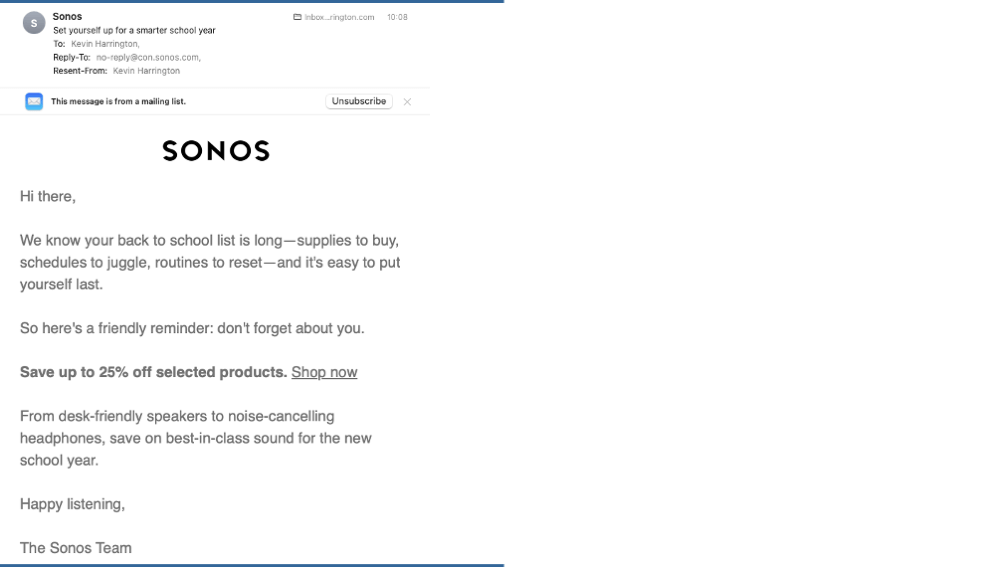
I received this email from Sonos and felt quite disappointed. Who on earth signed it off?
Here is the email text:
Hi there,
We know your back to school list is long — supplies to buy, schedules to juggle, routines to reset-and it’s easy to put yourself last.
So here’s a friendly reminder: don’t forget about you.
Save up to 25% off selected products. Shop now <hyperlink>
From desk-friendly speakers to noise-cancelling headphones, save on best-in-class sound for the new school year.
Happy listening,
The Sonos Team
The Core Problems
Generic Personalisation Failures
The opening “Hi there,” represents a fundamental personalisation mistake that research shows can reduce reply rates by up to 142%[1]. Despite having my name and subscriber information, Sonos chose the lazy route of generic greetings. Studies consistently demonstrate that using recipients’ actual names significantly improves engagement, yet this basic courtesy was completely ignored[2][3].
Audience Misalignment
Sonos’s core demographic consists primarily of affluent professionals aged 25-54, with over 70% having household incomes exceeding $100,000[4].
These customers are often childless professionals or parents focused on premium home audio experiences. The “back to school” messaging completely misreads their primary customer base, attempting to apply a retail strategy that simply doesn’t fit their sophisticated, quality-focused audience[4].
Irrelevant Campaign Strategy
Back-to-school marketing works best for businesses targeting parents with school-age children or students directly[5]. Sonos’s premium audio products aren’t impulse purchases driven by academic calendars. Their customers make considered decisions based on sound quality, home integration, and lifestyle enhancement[4]. The campaign timing and messaging show a disconnect from actual customer motivations and purchase drivers.
Best Practice Violations
Segmentation Failures
Effective email personalisation requires proper audience segmentation based on demographics, purchase history, and behavioral data[2][6]. Sonos clearly failed to segment their email list, sending family-focused messaging to customers who likely don’t have school-age children or any connection to academic schedules. Research shows that 79% of customers expect personalised experiences from brands[7], yet this email delivered the opposite.
Content Relevance Issues
The email’s focus on “supplies to buy, schedules to juggle, routines to reset” speaks to pain points that don’t exist for Sonos’s target market. Their customers are more concerned with multi-room audio integration, premium sound quality, and seamless home entertainment experiences[4]. The messaging completely missed their actual interests and needs.
The Broader Marketing Implications
Brand Perception Damage
Generic, irrelevant emails don’t just get ignored—they actively damage brand perception. When premium brands like Sonos send poorly targeted messages, it suggests they don’t understand or value their customers[8]. This is particularly damaging for a brand that built its reputation on thoughtful design and user experience.
Missed Revenue Opportunities
Sonos customers typically aren’t price-sensitive bargain hunters, they’re quality-focused consumers willing to pay premium prices for superior experiences[4]. The discount-first approach may actually devalue the brand in their eyes.
Recommended Improvements
Proper Personalisation
Start with basic name usage and segment based on purchase history, product ownership, and demonstrated interests. Sonos has rich customer data from their connected products that could enable sophisticated personaliation[9].
Audience-Appropriate Messaging
Focus on seasonal audio experiences relevant to their affluent, quality-focused customers: fall entertaining, cozy home atmospheres, or premium product launches. Skip generic retail calendar events that don’t align with their customer journey.
Value-First Communication
Lead with product innovations, exclusive experiences, or insights about premium audio rather than discount-driven calls to action that may cheapen the brand perception.
The Sonos email serves as a textbook example of how even successful brands can damage customer relationships through poor email marketing execution. Your disappointment is entirely justified and reflects broader industry failures in customer understanding and communication strategy.
Further Reading and References
[1] 10 Professional Email Layout Mistakes (and How to Avoid Them) https://martal.ca/professional-email-lb/
[2] What are the best practices for email personalization? – Dotdigital https://dotdigital.com/blog/best-practices-for-email-personalization/
[3] Personalized Email Marketing: 9 Strategies for Success – Mailchimp https://mailchimp.com/resources/email-personalization/
[4] What Are Customer Demographics and Target Market of Sonos? https://canvasbusinessmodel.com/blogs/target-market/sonos-target-market
[5] 10 back-to-school email marketing tips to inspire your next campaign https://dotdigital.com/blog/10-back-to-school-email-marketing-tips-to-inspire-your-next-campaign/
[6] Personalized Email Marketing Guide 2024 – Twilio https://www.twilio.com/en-us/blog/insights/6-tips-and-examples-for-personalized-email-marketing
[7] Back to School Marketing Prep Strategies https://www.higher-education-marketing.com/blog/marketing-prep-for-a-successful-academic-year-strategies-that-work
[8] Case Study: Sonos https://experimentzone.com/work/sonos-research-case-study/
[9] How Sonos Uses In-App Messaging to Personalize the Customer … https://www.airship.com/blog/sonos-in-app-messaging/



Leave a Reply